
Last updated 12.04.25 — Another five years gone by and it’s time, yet again, to refresh the KKG list of professional knife sharpening services. I’m still a very very very very picky person, so rest assured, I’m not taking my mission lightly.
Again, the seascape has changed, and I’ve needed to trawl the web for new, high-quality options. And, although there’s a bevy of fish in the internet ocean, I continue to discover that catching (and keeping) a quality professional knife sharpener is not easy. So, at the moment, I have only three top-tier services I can heartily recommend—two old and one new.
Top Knife Sharpening Services
Life is short and I have little interest in dissing sharpening services. It’s a tough enough grind as it is (pun intended!). So please know this—all three of these finalists have been tested by yours truly and are good to go. I’ve done the heavy screening and any sharpening services deemed unworthy have been banished from these pages. Who’s left are the cream of the crop (starting with my two originals):
Bozeman Knife Sharpening (bozemanknifesharpening.com)
Where: Bozeman, MT / Contact: Bob Tate
KySharp (kysharp.com)
Where: Berry, KY / Contact: Phil Fox
Sharp Stuff (http://sharpstuff.co)
Where: Spokane, WA / Contact: Steve Schmauch
What They All Have in Common
Although I still have some quibbles, and some of these sharpeners do certain things better than others, all of these top-drawer pros understand how to achieve true sharpitude. And they can do it without hurting your loved ones, er, your knives. On top of this, they are great communicators, responsive, and genuinely nice guys. They love what they do and they love making the kitchen a sharper and better place.
These knife sharpening services are all:
1) Deeply experienced. All have sharpened, literally, thousands of blades and many have been doing it for decades.
2) One-man bands—they, personally, do the sharpening themselves. They have no assistants, no trainees, no life-long buds who sub in on the grinding belts if they get buried. Nope. Nobody touches your knives but the owner/operator. (Could I be any clearer?)
3) Well-established bricks-and-mortar businesses, as well as mail-order outfits. And they have clear instructions and procedures (well, some clearer than others—oops, I’m already quibbling) as to how to send them your beauties.
Finally, and maybe most important of all, I have personally auditioned each one. Yes, pinky promise (as my teenage daughter used to say). I am not simply parroting what I’ve heard or read about or garnered from multiple websites, but sharing my own personal experience as a fellow consumer. And, this time around, believe me, it was a ton of work.
Be Careful
These three pro knife sharpening services only represent a fraction of the pro sharpeners I researched and considered. Nonetheless, I’m pretty sure there are more decent knife sharpening services out there. So just because a knife sharpener you know and love doesn’t appear in these pages, doesn’t mean they’re not high-quality. On the other hand, please please be careful who you give your knives to. (Read Finding a Professional Knife Sharpening Service for more advice.)
I’ll begin with the two knife sharpening services from my original review and then proceed to the one most recently sampled.
Very Important Note: I do not receive a penny from any of these knife sharpening services for referring customers. It’s a freebie. I also pay full-price—the same as everybody else. If for some reason this changes, I’ll be the first to let you know!
I first found out about Bozeman Knife Sharpening (formerly Seattle Knife Sharpening) by accident from a YouTube video. Early on in my knife-sharpening education, I stumbled onto a clip of a very satisfied Bozeman Knife customer showing off his newly sharpened set of Global knives. He sliced off slivers from a sheet of paper with ease and raved about the sharpitude. I was entranced.
I went to the Bozeman website and liked what I saw (literally as well as figuratively—it’s a nicely designed site). The business seemed to be a small operation by one guy, Bob Tate, which I found attractive. Personalized service.
Tate had learned his craft from Bob Kramer, one of the most well-known and highly-respected bladesmiths in the U.S.A. And—judging from what he wrote on his site—Tate seemed open and friendly. I wrote him an email or two with questions about his craft, how he ground his edges, and he answered back quickly.
Sharpening Technique
His method is slightly unorthodox, but wickedly sharp. Bob explained that he tailors the primary bevel for each knife. Starting at the edge, he grinds as steep an angle as he thinks the steel can take, and then blends it up into the rest of the blade, up towards the spine. It sounds thorough, and it is.
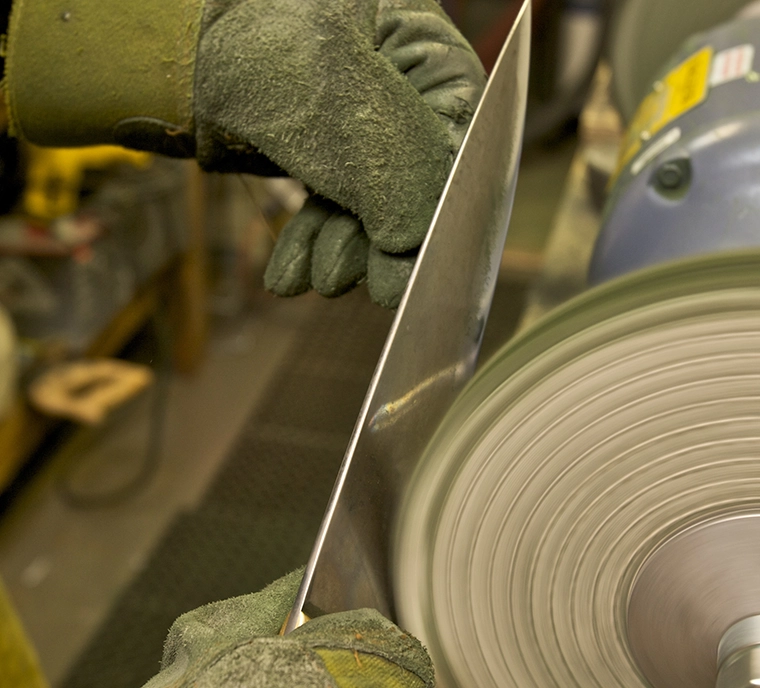
As he mentions on his site, it’s a 6- to 7-step process using belt sanders and polishing wheels along with sharpening compounds. On a German-style knife this often means thinning down the blade a bit and creating an edge angle much sharper than usual. Fine with me!
Shipping/Turnaround
I boxed up a bunch of my knives as per Bob’s instructions and sent them off to Washington state (long before he moved to Montana). Almost two weeks later I got them back (those days I lived on the other side of the country, near NYC). I was a little disappointed at the turnaround time—but the knives, the knives! They looked sharp.
Windup
I grabbed a newly sharpened chef knife and immediately tried what I’d seen the guy in the YouTube video do. Oh, yeah. Right through paper, not only without resistance, but not leaving any roughness either. The cut edges of the paper were perfectly smooth—like I’d used a pair of German scissors. I zipped through a tomato—the first time in years without a serrated knife in my hand. This was as true for the Henckels knives I’d sent him as my Japanese-made Global.
As if this were not enough, Bob was also big on follow-through. He recommended the best type of hone to use to keep my knives sharp as long as possible (see My Favorite Honing Steels), and even gave me honing instructions over the phone. What a guy! I was off to a great start with my first professional knife sharpening service.
Rates
Bozeman charges $2.00 per inch (of the blade), plus a $5 handling charge for each order (not each knife). Bent tips are fixed for free; broken tips are $10. For any other types of repair you should email or call.
BOZEMAN UPDATES
• In 2020 I shipped out another box of knives for sharpening and when I got them back it felt like Christmas in July. Spot-checking sharpitude (and this batch was much larger than my original) proved that Tate had not lost his touch.
• In spring of 2024, a good friend of mine who loves to cook, but had terribly dull knives, finally heeded my advice and sent his blades off to Tate. Stunned by the sharpitude, he’s now a devotee.
• If you’re hungry for more, be sure to read my two-part interview with Bob.
KySharp (as in “Kentucky” Sharp) first caught my eye, not only because it had a clean and inviting home page design. But also, on that very first page, said just the kinds of things I wanted to hear. Things like, “this [sharpening] process removes only a minimal amount of metal and gives a very strong, long-lasting edge.” Minimal metal, long-lasting edge. Bingo!
As I dug in deeper, the story only got better. The owner/operator, Phil Fox, has had a love for quality knives since he was kid, holds degrees in physics and engineering, specializes in sharpening only kitchen knives, considers himself a craftsman (not a “sharpener”), and has worked for years to discover a sharpening system that can consistently produce razor sharp edges. Double bingo!
Sharpening Technique
I emailed Phil some questions about his sharpening technique and the difference between his three sharpening rates. He explained a two-stage process, simpler than Bob Tate, but clearly high-quality. He said he didn’t differentiate between German and Japanese knives and standardly aimed for 15 degrees on every blade.
Shipping/Turnaround
While I packed up the knives—super-easy because of Phil’s incredibly clear and well-thought-out website—I mused about why a man with degrees in physics, engineering, and math (yes, I forgot to mention) would opt out of the traditional job market and hole up (with his wife and two kids) in the wilds of Kentucky sharpening knives. People never cease to intrigue. . . .
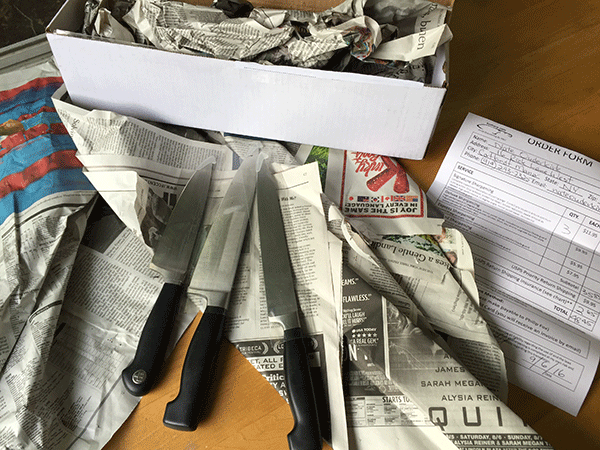
Five days later, including a weekend, I got the knives back from KySharp! Whoa. The Blue Grass State felt as close as Jersey. And—which was just as sweet—I hardly recognized the knives. All dings and bends had disappeared including a broken tip I couldn’t tell ever existed. The edges looked smooth, consistent, and polished. (Below: Unpacking my booty from KySharp.)

Windup
I immediately carved a half moon out of a folded-over page of magazine paper (a test I picked up from a Bob Kramer video) and the blade cut effortlessly, leaving a smooth edge, no raggedness. That’s the way they do it in Kentucky. “Yay, I’ve found a new professional knife sharpener!,” I silently cheered.
Rates
For his top-of-the-line Signature Service ($12), Phil sharpens at 15 degrees, adds a mirror polish bevel, and fixes anything that needs to be repaired (broken tip, chip removal, bolster reduction, etc.). His Deluxe Sharpening ($10) is the same as Signature, but doesn’t include any repair. And Serrated Sharpening ($8) is exactly as the name implies, for serrated blades only. (Which is great, because some services won’t touch serrated.)
And now for the new sharpening service. . .
Over four years back, Steve Schmauch of Sharp Stuff, left a charmingly self-promotive entry about his sharpening service in the comments section on this very web page. His creds seemed promising. But I wasn’t betting the farm—because his pricing was such a bargain, it made me wary.
Nevertheless, I made a note. And when it came time to update my reviews of professional sharpeners, I actually remembered, and scrounged up his contact info. Good for me, and you—for the dude’s got sharpening chops and is now KKG-approved.
Steve claims he’s sharpened over 100k knives which boggles even my kitchen-knife-addled mind. Yet, believe it or not, I’ve often found quantity does not necessarily guarantee quality. Fortunately for us, in Mr. Schmauch’s case, it does, and he has proved himself a top-notch sharpener. Plus, having so much experience under his belt gives him the chops to deal with problematic issues.
Sharp Stuff is located in Spokane, WA—due west and across state from Bob Tate’s old stomping grounds (when he lived/worked in Seattle). And, funny enough, Schmauch reports he has sharpened knives previously done by Tate. A tough act to follow, but, apparently—no problem for Schmauch.
Sharpening Technique
Because Steve has seemed a bit protective about the fine points of his knife-sharpening craft, I haven’t bugged him much about specifics. Nonetheless, he explains the generalities of his process on his website—three steps, low-speed, etc.—all the most important things you need to know.
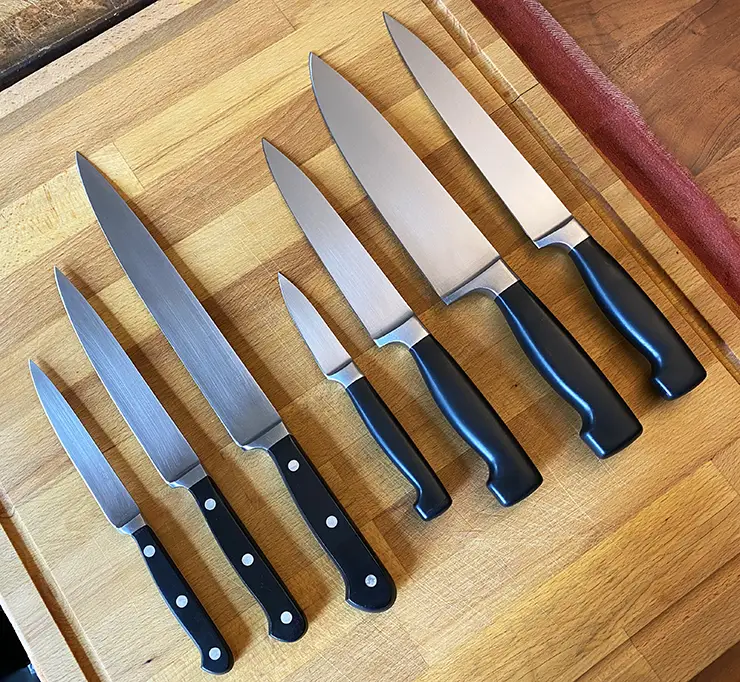
He will sharpen at either 15 or 20 degrees depending on his sense of the knife and its use. But you’re welcome to specify 15 for most any knife you send him; and that’s what I did. Make sure to let him know in an email and/or in your knife package. (Below: Wusthof Classic knives after sharpening by Sharp Stuff and Henckels Four Star knives by KnifeFlight.)

Shipping/Turnaround
Steve turns his jobs around faster than greased lightening. The first batch of knives I sent him had a total round-trip—from when I dropped them off at the post office, to the day they arrived, sharp, on my doormat—of a mere five days. And the second batch fared only a day longer. Granted, I’m in the middle of the country and he’s in the Northwest. So if you’re down in Florida, you’ll probably need to add a day or two to your expectations. But he prides himself on getting orders sharpened in a day.
Windup
Schmauch’s freshly-sharpened blades were meticulous—perfectly even bevels, along with a smoothly ground-down bolster or two. And they performed just as snappily as they looked. They whisked through my two-tiered gauntlet of tests (newspaper and tomatoes) with hardly a hitch. (Go to Sharpness Test Results to find out how each professional sharpener scored.)
Rates
Like KySharp, Steve charges a one-size-fits-all flat rate: all plain knives are $7, all serrated knives are $8—regardless of length or size. Which is a bargain—until you add on a $15 handling fee (for mail orders only). This bumps Sharp Stuff up to the second-most expensive option of these four sharpeners. Is he worth it? It all depends. . . (see Money, Money, Money below).
For any repairs, Steve charges $4 extra per knife—which includes fixing a bent tip along with a variety of other issues (chips, swales, etc.). Two of the pro sharpeners covered in this review fix bent tips for free, and one charges only an extra $2. So, if you have a number of knives with bent tips only and need to scrimp, you might take this into consideration.

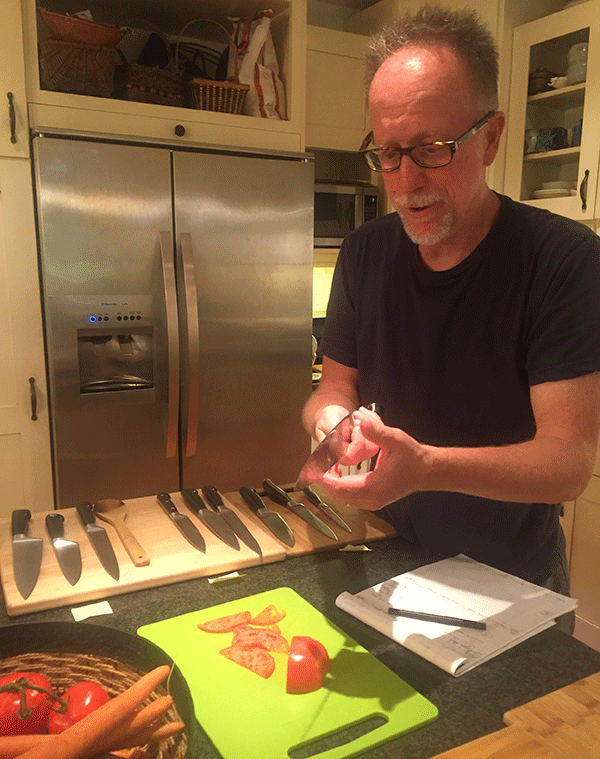
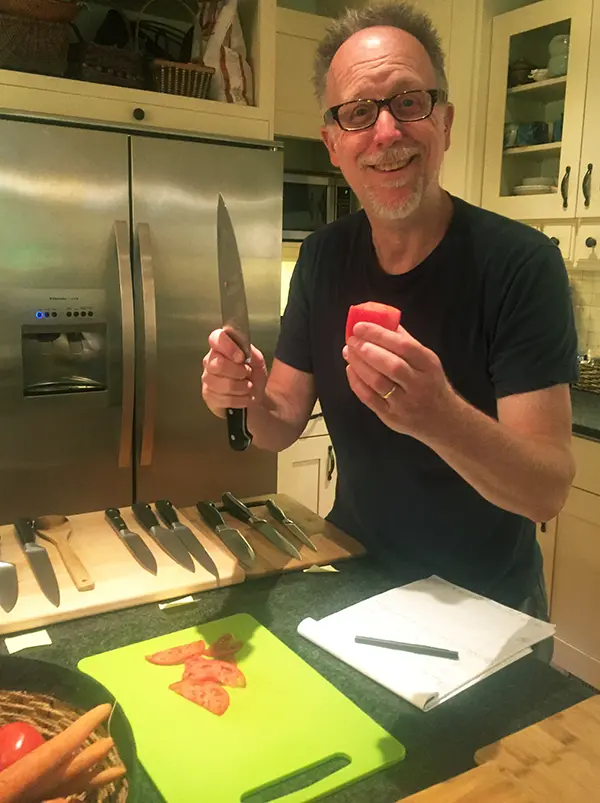
(Above: KKG tomato testing a Zwilling Professional S chef knife.)
Sharpness Test Results
My sharpness testing consists of two parts—magazine paper and tomatoes. The magazine paper test is an excellent starting point while the tomato test, which is much more demanding, can reveal more specifics. (For more about my methodology, click down to Sharpness Testing Method in the postlude of this article.)
Like the two professional knife sharpeners from my original review, the new sharpeners’ knives (Sharp Stuff) passed the magazine paper test with flying colors. Thus, the tomato test results are what help the most in analyzing and evaluating the sharpitude of all of the sharpening services and coming to conclusions.
A tomato test rating of:
excellent = little resistance, minimum pressure, no weak spots
good = additional pressure needed or had weak spots
OK = significant pressure demanded and/or sawing back and forth
1st Place, Top of the Class
Bozeman Knife Sharpening stays at the top, the uncontested King of Sharp. Over twelve years (since 2012) and two review updates, Bob Tate’s expertise still shines through.
Granted, I haven’t, personally, sampled Tate’s sharpening for seven years, and who knows, he might have gotten worse (yeah, right). But no one, so far, can match his razor-sharp edges and rock-solid consistency.
Bozeman Knife Sharpening
($2.00 per inch, standard rate—plus $5 handling per package)
– Calphalon santoku, 7-inch: excellent plus
– Global santoku, 7-inch: excellent to good, no weak spots, minimal pressure
– Henckels Pro S chef, 8-inch: excellent plus
– Wusthof Classic Ikon chef, 9-inch: excellent plus
(Note: Unlike all the other knives tested below, the first three knives for Bozeman were not freshly sharpened. They’d been used in our kitchen, but honed regularly.)
2nd Place, but No Slouches
Both KySharp and Sharp Stuff come in close behind Bozeman in a virtual tie. Two out of three of KySharp’s blades were uniformly excellent while Sharp Stuff’s varied between excellent and good. On the other hand, Sharp Stuff produced a boning knife that reached excellent plus while KySharp had a slicer that was only good. So they’re both, on average, in the same sharpness territory.
Like Bozeman, it’s been a while since I’ve shipped knives to KySharp—eight years gone by (since 2016). My hunch, knowing Phil has an engineering background and a passion for perfection, is that he’s only gotten better. But it’s just an educated hunch. . .
KySharp
($10 per knife at the “Signature” rate)
– Wusthof Gran Prix chef, 6-inch: excellent
– Henckels Four Star chef, 8-inch: excellent
– Henckels Four Star slicer, 8-inch: good, better mid-blade than tip
Sharp Stuff
($7 per knife—plus $15 handling per package)
– Wusthof Classic slicer, 9-inch: excellent to good; heel a little weak, tip especially nice
– Wusthof Classic chef, 8-inch (super-thick blade): excellent to good; heel weak, tip excellent
– Wusthof Classic utility, 6.5-inch: good to excellent; heel weak
– Wusthof Classic boning, 6-inch: excellent, maybe excellent plus; strong along entire edge, including problematic curved heel
Sharpness Summary
From these tests on these knives, it would appear First- and Second-Place sharpening services are not that noticeably different in sharpitude. If you are finicky and truly appreciate super-sharp edges, stick to First-Place (Bozeman). Otherwise, feel free to go with any one of these sharpeners, or let other considerations guide your choice (i.e. price, turnaround time, etc.).
Please remember that all the knife sharpening services considered in this article stand head-and-shoulders above the majority of other pro sharpening services. And all produce knives sharper than those in probably 90 percent of home kitchens in the U.S. of A.
Japanese Blades
Almost all the kitchen knives I’ve sent out to be sharpened have been Western-style knives made with German steel—not Japanese. There’s a distinct difference between German and Japanese steel that can impact sharpening and sharpitude.
German steel is softer, yet tougher, while Japanese is harder, yet more brittle. Japanese knives can usually be sharpened to a finer, sharper edge and hold it longer. But, those very same edges, can also be more delicate, more susceptible to damage. (For more on this, please see my article Best Chef Knives — Six Recommendations.)
All of the professional sharpeners in this review sharpen Japanese factory-made knives on a regular basis (Shun, Global, MAC, etc.). But only Bozeman has sharpened Japanese knives for me, personally (with terrific results).
This said, I would be comfortable sending my Japanese knives (factory-made) to any of these sharpening services.
Money, Money, Money
OK, lets do a price comparison: What would it cost to send each of these sharpening services four knives, or eight knives, two of the knives with bent tips?
Remember: Only one service, Bozeman, prices by the inch. The other two services price by the knife, regardless of size.
For shipping costs, I’ll use the current price of a USPS medium flat-rate box ($38 round-trip) which is one of the most inexpensive and easy-to-do options. Also, $100 of insurance is automatically included in both USPS and FedEx flat-rate boxes.
In the chart below, I’ve listed the sharpening services from least to most expensive. Although notice that KySharp and Sharp Stuff, in the eight knives column, should, technically, swap places.
Hypothetical Knife Packages
Four knives: 8-inch chef, 8-inch slicer, 7-inch santoku, 4-inch paring = 27 inches (w/two bent tips).
Eight knives: (2) 8-inch chefs, (2) 8-inch slicers, (2) 7-inch santokus, (2) 4-inch parings = 54 inches (w/two bent tips)
Cost Comparison Chart—Including Shipping/Insurance*
| Sharpening Service | Four Knives | Eight Knives | |
|---|---|---|---|
| KySharp (2x$12-Signature, 2x$10-Deluxe / 2x$12-Signature, 6x$10-Deluxe; plus $38) | $82.00 | $122.00 | |
| Sharp Stuff (4x$7 + $8 tips / 8x$7 + $8 tips; plus $15 hdlng fee, plus $38) | $89.00 | $117.00 | |
| Bozeman Knife Shrpng (27x$2, tips free / 54x$2, tips free; plus $5 hdlng fee, plus $38) | $97.00 | $151.00 | |
| *For shipping cost, using current price of a USPS medium flat-rate box—$38 round-trip. | |||
Cost Conclusions
When you scan the chart above, you’ll notice:
1) There’s only a minor price difference ($5-7) between the two second-place sharpening services—KySharp and Sharp Stuff. They are as closely-matched in pricing as they are in sharpening quality.
2) There’s a substantial difference between what you’ll pay the most economical sharpener (KySharp) versus the most expensive (Bozeman). The price gap between them runs anywhere from $15-29.
Which begs the 64-dollar question: Is Bozeman worth the extra moola?
My answer is. . .yes, and no. It depends on: 1) your level of cooking experience and, 2) how you treat your kitchen knives.
If you plan to use Bozeman, you really should be sure you’re going to fully appreciate his sharpitude—and make it last (i.e. protect your knife edges). Otherwise, paying a premium will be a waste of good money. And you shouldn’t use his high-performance edges to cut through anything you darn please—like slamming into frozen cookie dough (don’t laugh, one of Bob’s customers did and complained about a chipped edge).
For me, in most cases, Bozeman is absolutely worth it. But for other home cooks, this may not be the case. In the end: Know thyself and thy cheffing style.
Knife Repair Summary
If you’ve got a knife you know needs some minor repair work, here’s a quick recap of the three sharpening services’ repair policies:
– Bozeman Knife Sharpening will straighten a bent tip for free; but fixing a broken one is $10. Small chips and other smaller issues, he’ll probably do for free as well. But a “big chip” repair will cost $10.
– KySharp does not charge for repairs a la carte, but folds them into his Signature Sharpening Service which is only $2 more than Deluxe. So you pay only $2 for everything from a removing a chip or smoothing out a swale, to fixing a broken tip. Best deal ever if you’ve got some seriously beat-up knives!
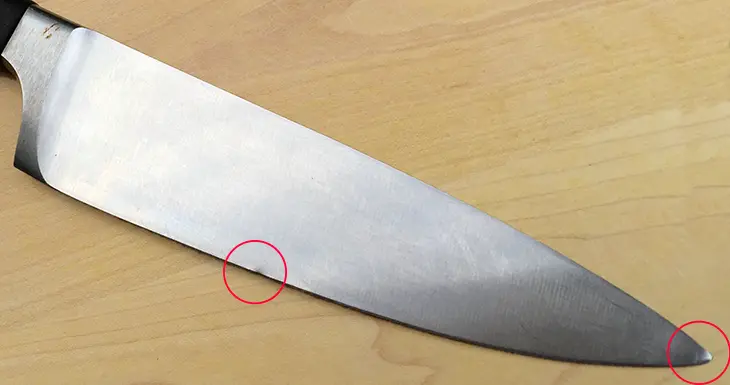
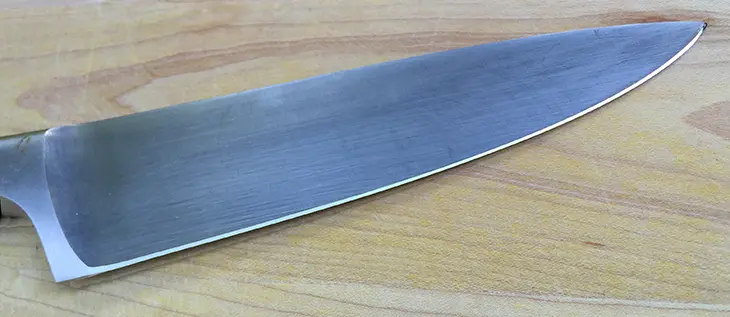
(Above: Wusthof Grand Prix chef knife with ding in the cutting edge and a bent tip. Below: Same knife after being sharpened and repaired by KySharp.)
– Sharp Stuff doesn’t do any repairs for free. Even a bent tip will cost $4. On the other hand, that same $4 will cover a whole range of issues—from a chip, to a swale, to grinding down a bolster.
Important note: With all of these professional sharpeners—if you have any repair issues you are not clear about, make sure and ask ahead of time. That way you’ll avoid any misunderstandings.
Shipping Your Knives
In case you haven’t already figured it out, shipping costs are a pain-in-the-neck. And depending on how many knives you ship, they can match the cost of the sharpening itself. So, it’s worth taking a moment to come up with a plan.
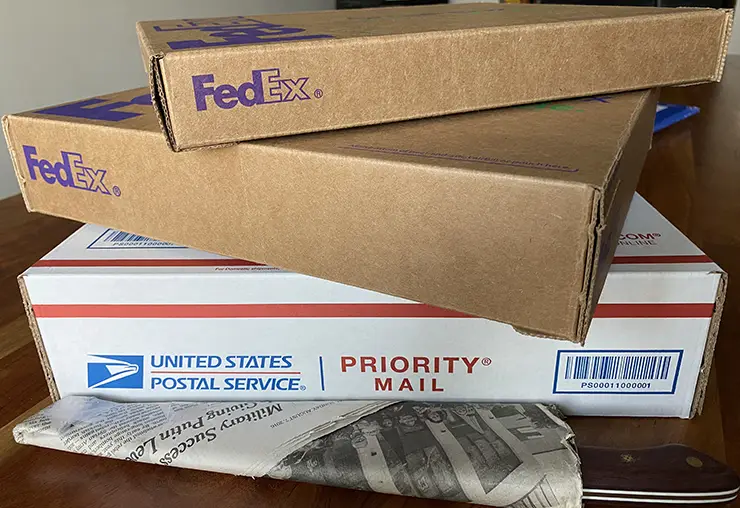
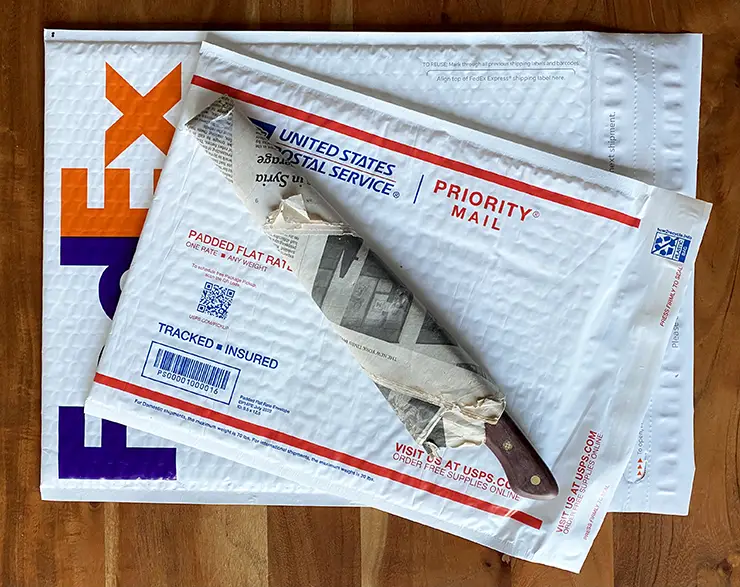
One major fact to remember: Shipping, in accountant-speak, is what you call a fixed cost—you’ll pay the same price to ship ten knives as you will for one. Thus, if you want to get the best value per knife, always try to send at least three or four. Better yet—seven or eight! (Below: FedEx and USPS flat-rate, padded envelopes.)

Shipping Options
(Note: Saturday is considered a business day for all carriers.)
USPS
(Box/envelope included in rate)
• USPS padded flat-rate envelope (12.5 x 9.5): $10.85
• USPS medium flat-rate box (13.5 x 12 x 3.5): $19.15
—
Priority turnaround: 2-3 days. Ship Friday afternoon, arrives Monday or Tuesday.
$100 insurance included
Priority Mail Flat Rate Products
FedEx
(Box/envelope included in rate)
One Rate (flat rate in U.S.)
• FedEx bubble pack envelope (reuseable): $12.60
• FedEx small box (12.5 x 11 x 1.5): $15.10
• FedEx medium box (13.5 x 11.5 x 2.5): $19.00
—
2-day, 3-day the same price. Ship Friday afternoon, arrives Tuesday (end of day).
$100 insurance included
FedEx One Rate Shipping
UPS Ground
(Supposedly, UPS supplies free boxes. But I did not find that to be the case in the stores I visited. Perhaps you need to create an account and order them online.)
• Large padded envelope: $16.45 (est. shipping only—no flat rate)
• Small box (same as padded envelope): $16.45 (est. shipping only—no flat rate)
—
UPS Store large envelopes: $3.00
UPS Store small box (12.25 x 9.5 x ??): $3.50
—
4 days turnarround. Ship Friday afternoon, arrives Wednesday (end of day)
$100 insurance included
UPS Domestic Shipping
(Below: FedEx [small, medium] and USPS [medium] flat-rate boxes along with newpaper-sheathed chef knife.)

Shipping Recommendations
Currently, the two best shippers seem to be USPS and FedEx. Both offer flat rate boxes which can, not only save you postage, but eliminate the need to buy a box (around $3.50).
I love flat-rate shipping because it relieves you of the stress of wondering what kind of bill you’re going to rack up. You’re guaranteed up front. Once you choose the carrier and box size, you know no matter how many knives you stuff into it and wherever you decide to ship it to (Montana, Kentucky, etc.), it’s going to cost exactly the same.
USPS’s largest Medium Flat Rate box (see above), the size I recommend, will fit a whole lot of knives. I’ve personally packed as many as twelve, over half of them 6- to 9-inch chef knives. And the cost? Only $19.15. That’s lit (as my daughter’s gang would say)! I shipped a box all the way across the country from Westchester, NY to Seattle, WA for only $19.15.
FedEx’s medium box (see above) is not quite as big, but about the same price. Buuut, if you don’t need that much space, you can use FedEx’s small box instead and save $4 each way. It will easily fit four to five 8-inch chef knives along with a couple of paring knives. Using the small FedEx box will slash your total, round-trip, shipping costs to only $30, beating out USPS by $8.
You can pick up flat rate boxes (and envelopes) at any post office or FedEx store for FREE. Can you beat that?
Packing Your Knives
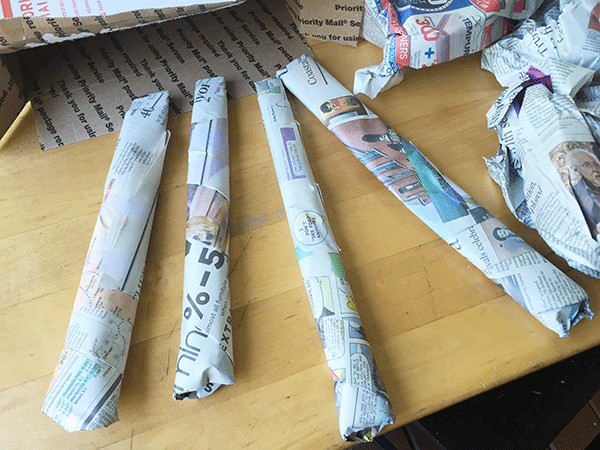
The simplest and cheapest way to pack up your kitchen knives is to wrap them in newspaper. Wrap each knife separately and secure with tape. (Don’t put anything special on the point.) There are styles and techniques of wrapping, but any kind of wrap that thoroughly protects the edge and point from doing any damage will work.
Here are two video links that show contrasting techniques—one on Bozeman’s site and another on Sharp Stuff’s. Steve at Sharp Stuff recommends wrapping your knives in an old towel. Personally, I prefer newspaper (Bob Tate’s method) because it’s more compact, more flexible, and will tend to weigh less.
Final Wrap-up
To some, it may seem like a suitcase of money, a luxury, to send their kitchen knives out to a professional for sharpening. But it really isn’t. Not when you understand that:
• Your knives are the most valuable tools in your kitchen—yes, even more than your pans. Because if you try creating a meal without a knife, you’ll be ripping apart fruits and vegetables with your fingers!
• A quality professional knife sharpening job can last an amazing amount of time. It all depends on how well you treat your beauties when you get them home. Depending on use, your newly-sharpened blades could stay sharp for three years or longer. . .
There are just three things you must do to make your kitchen knives’ sharp edges last:
1) Not slice or chop on anything other than the right kind of wooden or plastic cutting board.
2) Not use your knives to power through frozen food, bones, or anything else they were not designed to do.
3) Hone them regularly with a ceramic hone.
If you take, say, Bozeman Sharpening’s price (the most expensive) for eight knives ($150) and divide it by three years—you pay $50 a year. For keeping your kitchen knives super-sharp 24/7. Doesn’t that seem worth it?
• • •
P.S. If you have any questions whatsoever, please feel free to enter them in the comments section at the very bottom of this page!
POSTLUDE . . .
Japanese Knife Sharpening Services
Every knife sharpened (with one exception) in my knife-sharpening odyssey was a Western/German, factory-made blade. But there’s a whole world of Japanese-made traditional knives out there that need sharpening as well. Most of these are forged knives produced by bespoke Japanese bladesmiths (which Global is not). And they should only be sharpened by a specialized service—usually using water stones (often a combo of motorized and manual). I do not currently own any of these thoroughbred Japanese knives, so this particular market is outside my personal experience.
But if you own a traditional, or bespoke, Japanese blade, here is a list of Japanese knife sharpening services with excellent credentials and huge reputations. They are not cheap—but you are probably getting a half hour or so of a master sharpener’s expert care. If you value your Japanese knife and wish to use it for years and years, do not skimp!
Korin [korin.com]: Written and talked about everywhere, they are the name brand in Japanese sharpening—located in good old NYC. Recommended by the The Wall Street Journal and, apparently, everybody in the known world.
Carter Cutlery [cartercutlery.com]: Created by the legendary bladesmith, Murray Carter, the twist being he’s an anglo who studied in Japan 18 years. He mastered age-old Japanese knife making and sharpening techniques and became a 17th generation Yoshimoto Bladesmith. Fascinating story. Still sharpens everything himself.
Bernal Cutlery [bernalcutlery.com]: A foodie fixture in San Francisco—their sharpening page has “super-high-quality” stamped all over. My email chats with them have seemed to confirm this.
(Important update: I ended up sending Bernal a batch of six paring knives with a lone boning knife. Sorry to say, the results were inconsistent and underwhelming—from good to excellent to ok.)
Canada Knife Sharpening
After the U.S.A., my Canadian visitors number the most. So here’s a couple of knife sharpening services I can recommend North of the Border:
New Edge Sharpening [halifaxknifesharpening.com]: I met the owner, Peter Nolan, online a few years back and have been quite taken with his dedication to the craft of sharpening. He sharpens by hand, only using Japanese waterstones, so he should be on my “Japanese Knife Sharpening Services” list above as well. He’s a humble student of the age-old craft. Located in Nova Scotia.
Tosho Knife Arts [toshoknifearts.com]: Both partners have solid credentials and much promise and specialize in handmade Japanese knives. Located in Toronto.
Sharpness Testing Method
This is where the knife nuts will all gravitate and everyone else just glaze over. . .
In the early days, when a batch of blades came in from a professional sharpener, I’d grab some magazine paper and sliver off corners with the newly-sharpened edges. Cool. Nine out of ten knives would perform excellently and whizz right through. I could tell all the knives were in the proper sharpness universe and certainly sharper than knives in at least 95 percent of all U.S. home kitchens. But I still felt I was skimping on analysis. I wanted a more accurate, and more consistent, basis of comparison.
After some trial and error, I’ve come up with a two-part system. . .
part one: Magazine Paper Test
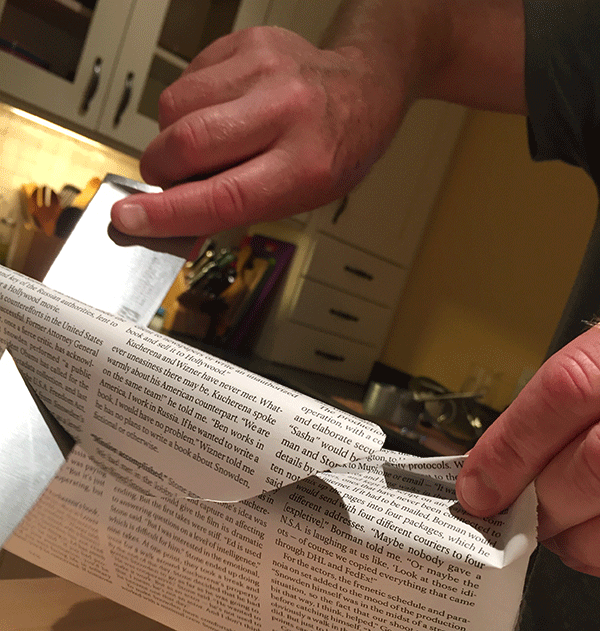
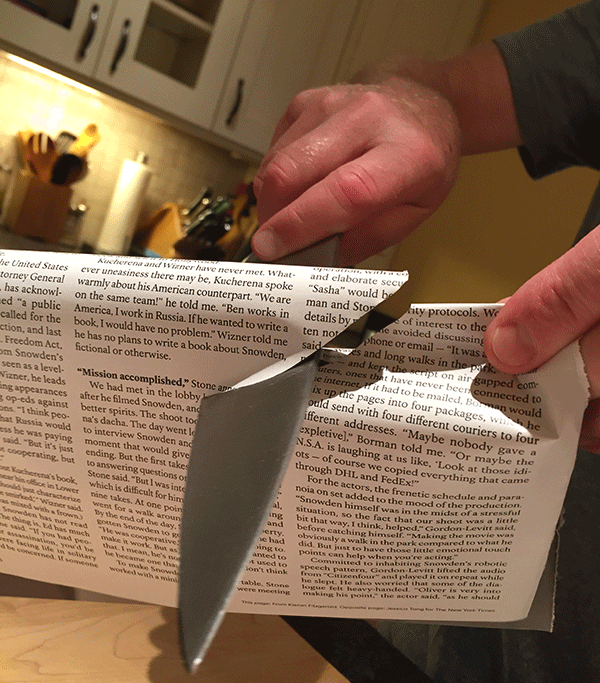
First, with each knife, I try to carve half moons through loosely folded-over magazine paper (as already mentioned—something I culled from Bob Kramer). The object is for the knife to enter and exit the paper without resistance and remove a complete half moon (really, more like an orange slice shape). Ideally, the edges of paper the knife cuts through should be smooth without any toothiness, thus, confirming a extra level of sharpitude.
In short order I’ve discovered the magazine paper test is not demanding enough. Although once in a while I might find a knife that has a problem with exiting the paper, in general, most knives that come back can carve full, and pretty smooth, half moons. Darn. (Below: sharpness test with magazine paper.)
part two: Tomato Test
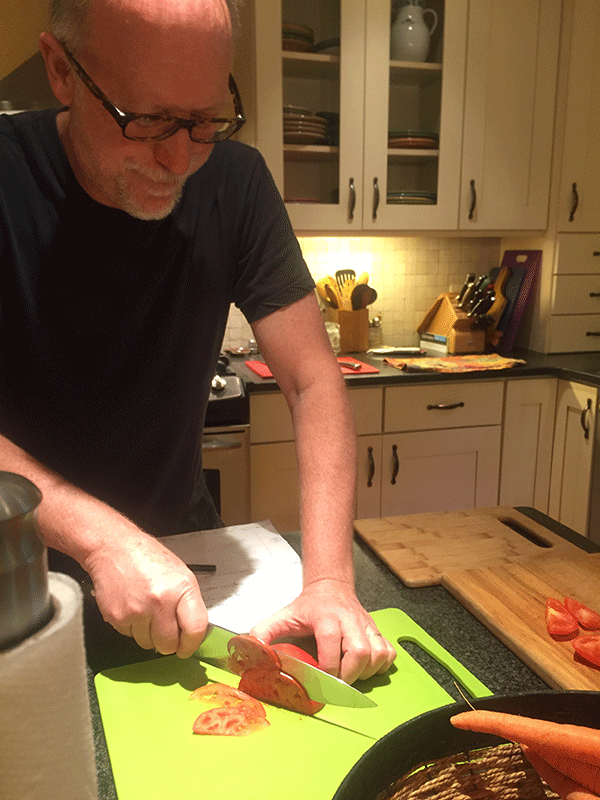
Second, I’ve added the classic and most knife-problematic vegetable to the mix—the tomato. (Yes, I know, it’s really a fruit.) I’ve quickly discovered tomatoes are much much better at revealing how sharp a blade is. Unquestionably more exacting than paper. Good, but I’ve needed to codify my procedure—because I wasn’t being nearly consistent and detailed enough in my recording of tomato data. (Wow, do I sound like a knife nerd or what?)
Number One, my tomatoes weren’t all the same exact type or in the same ripeness. Big diff, folks. And Number Two, I wasn’t paying close enough attention to exactly what kind of resistance, or lack or resistance, the knife edges were giving me all along the entire edge. Plus, I wasn’t applying the exact same types of cuts or being diligent enough about exerting the same amount of pressure. Ha!
But learning from these initial attempts, I’ve finally come up with a finalized series of parameters for testing knife sharpitude with a tomato.
Tomato Test Parameters
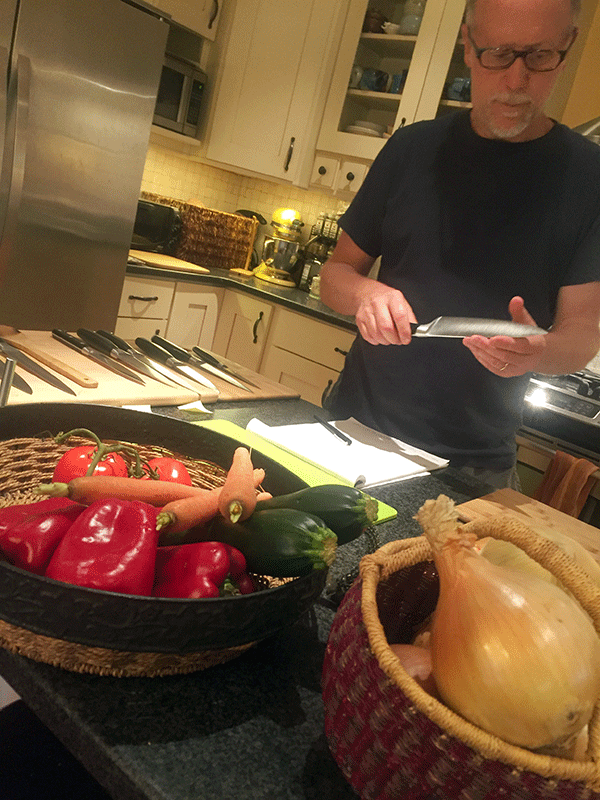
#1) The tomato: The best tomato—because it’s the most challenging—has proven to be a common, ripe, hothouse tomato. The kind most grocery stores sell all year round and come quaintly displayed in vined bunches. No plum tomatoes, too firm. No other kind of tomato in general, too firm. And no tomatoes that haven’t softened into ripetude.
#2) The cut: Every cut needs to be a push cut. First, because it’s a cut that demands the most from the cutting edge, and second because it’s fairly easy to track and control.
#3) Edge consistency: Multiple push cuts are needed to determine whether the sharpitude is consistent along the entire edge. To suss out weak spots. So I perform a minimum of three push cuts, each starts from a different area of the blade—tip, belly, heel. (Have you nodded off yet?)
#4) Pressure/weight: Ideally, a finely-sharpened knife should take very little downward pressure (or hand/arm force) to break through the skin of the tomato. And it should be one, uninterrupted push. Any need to saw back-and-forth is evidence of inferior sharpitude.
Unfortunately, because of the varying weights of the knives themselves (some widely), downward pressure is often the trickiest element to gauge. Larger, and older, knives that carry more heft always seem to slice more effortlessly. So be it . . . just something to be aware of.
SHARPNESS TESTING SYSTEMS Interestingly enough, in one of my queries to the pro sharpeners, I had asked one if he tested his edges to confirm their sharpness. And he’d said, early on in his practice, in an effort to precisely quantify how he was doing, he’d tried out the Edge On Sharpness Tester. But he had found the device so inconsistent that he quickly sold it and has since simply relied on his fingers, his eyes, and, in a pinch, shaving a few arm hairs—methods which seem to be the norm for most pros.
(Below: KKG’s journey through the Tomato Test for sharpness.)
Kitchen Knife Supply Pipeline
The whole knife gathering, mailing, receiving, and evaluating process has become more complicated than it was when KKG first started. The main problem being that, from my own kitchen knife collection, I can’t scrape up enough knives that badly need sharpening.
My solution? Offer free knife sharpening to my friends and borrow their kitchen knives!
The only mildly horrifying thing is discovering what sad condition many of my friend’s kitchen knives are in—nicked edges, bent tips, scratched up blades. Poor babies . . . but excellent trial-by-fire for new knife sharpening services.
Kitchen Knives List
Which knives I sent where. . .
Bozeman Knife Sharpening
Henckels Professional “S” chef, 8-inch
Henckels chef, 6-inch (natural wood handle)
Global G-48, 7-inch
Sabatier slicer, 8-inch
Calphalon santoku, 8-inch
Henckels Professional “S” paring, 4-inch
Henckels Four Star paring, 3.5-inch
KySharp
Wusthof Grand Prix chef, 6-inch
Henckels Four Star chef, 8-inch
Henckels Four Star slicer, 8-inch
Sharp Stuff
Wusthof Classic slicer, 9-inch
Wusthof Classic chef, 8-inch
Wusthof Classic utility, 6.5-inch
Wusthof Classic boning, 6-inch
Wusthof Classic utility, 5-inch
Wusthof Classic paring, 4-inch


69 Responses
Is knifeflight still in service.? Their website is still up but unable to use their knife sharpening service.
Sorry, but Knifeflight was sold to Misen. Currently, we’re down to only three knife sharpening services that I can recommend. But, as far as I am aware, they continue to be top-notch.
Excellent article and great update. I use high end pocket knives and REK has put some alien type sharpness onto them. He’s a great sharpener, but he recently transitioned to making knives. He will still do belt sharpening, but no more custom profiles or mirror polishing. Just giving you info. Please keep us updated. Although I’m not a chef knife user, the variety of premium steel and different blades and grinds of many high-end pocket knives need expert service to keep them in their intended league of super knives.
Hi Michael, and thanks much for the feedback and info on REK. It’s really a pity he no longer does custom profiles because he’s soooo good at everything he does. I guess we’ll just have to take what we can get :)
–KKG
I was just getting ready to send some knives to Seattle but their website said they are closed. The owner has moved to Montana
After this pandemic year,maybe we could get updated
recommendations in case other small businesses have also stopped operating.
Thanks so much for checking in. Yes, I’ve been meaning to put a notation on the KKG site—sorry I’ve been so delayed.
– Seattle Knives is still not open, but is still intending to reopen in Montana.
– He will let us all know when he is ready for business on his Seattle Knives website.
– Meanwhile, I’m pretty sure all my other recommended pro sharpening service are open and ready for biz. I checked them all out around six months ago and they all were in business—one of the benefits of online business model.
– Please feel free to contact me if you have any other questions :)
–KKG
Hey KKG,
I posted awhile back for honing tips on a cleaver and a bird’s beak parer. I took your tip and tried stropping. I use it almost exclusively on my Japanese knives, since they are more delicate, and my honing rod works great on my German knives. It took awhile to get used to it but it’s great.
Since then, I’ve acquired quite a bit of knives, for cooking and as a hobby. I’ve also picked up some stones for some amateur sharpening on my German knives. It takes awhile but it’s fun! I don’t trust myself yet with sharpening the Japanese knives yet, so I’ll try D&R or Art of Sharp when it comes time for a sharpening.
Thanks
Gabe
Thanks so much, Gabe, for continuing to chronicle your kitchen-knife sharpitude journey :)
–KKG
Frank of Art of Sharp is indeed still in business. I just received my sharpened knives back and they are the sharpest theyve ever been. The cost was very modest and the turnaround time from the East Coast was exactly 1 week.
Thanks so much for the update!
Best, KKG
Th KKG ANONNYMITY section was a pleasant surprise in this era of “Influencers”. Absolutely the surest way to get the true measure of a service for the average customer. Respect for the process – if not the spelling :) Love your site! Just took an entire evening getting educated, and it was time well spent. Thank you!
Hey Mike!
That’s for your generous compliments! I hate misspelling stuff. . .thanks for the tip. Done!
Thanks, KKG
I was going to see if the Art of Sharp could sharpen my knives, since I live pretty close to his location. I contacted him by email last month but haven’t heard back. Is he still in business?
Hi Craig,
Sorry to say, I don’t think I can help much. Frank has been a bit stand-offish with me after the review came out. Not sure why. I have excellent relationships with all the other professional knife sharpeners I’ve reviewed and they’ve all been super appreciative.
December is a crazy month for everybody and Frank might have be buried in work and family. I think it would be worth writing him again and referring to your earlier email.
Anybody else out there have the latest on Frank of Art of Sharp in Chicago?
Best, KKG
I certainly appreciated your comments about the “top five”, but the West Coast (other than Seattle) sort of got left out—probably due to your own personal location.
Have you any comments about sksharpening (Mike Schmidt’s Knives) in Irvine, California? Their Website pre-prices their services by not charging by the inch (something of a commentary on the failure of the California Public Education system to teach basic math?), pre-sends you a specialized shipping container to save you the effort of newspaper-wrapping your knives and running to the post office, etc. The shipping container which arrives at your house contains “loaner” knives for your free use (and evaluation to purchase of course), and for those of us living near-by, offers a drop-off service to save a few bucks.
In trying to checkout their service I found Facebook reviews (BUT 4-5 years old, nothing current), YELP (again most were several years old), etc., but not much really truly current.
What have you heard?
Hi Henry,
You Californians make me laugh. Just like New Yorkers, you think the world ends outside your state lines :) If you look at where the pro sharpeners in my article reside, you’ll notice there isn’t a single one near me (in the NYC area) either. It’s just the way things panned out. . .
The main reason a CA company is not on the list is because, at the time of my last major revision, I didn’t find any sharpening services in CA that fit my first-cut parameters. In the case of SK Sharpening, it was probably because they’re not a single-man shop, but a more factory-like operation with many anonymous workers doing the sharpening. Not my thing. I highly favor small operations with one guy doing the sharpening—because quality control can be much tighter.
This doesn’t mean that SK Sharpening might not do a terrific job of sharpening. Why don’t you try them out and let us know? And if they’re great, maybe I’ll check them out at some future date.
Otherwise. . .take advantage of my research and pack up your knives and ship them off to someone you can trust (one of the pros in the above article)—just the way I do :)
Best, KKG
I find your reviews most interesting. Thank you for them!
I live in Canada (Quebec) and would be interested in such a service if it is available at all in the country. Any info you can provide?
Thanks!!
Hi Elisabeth,
You’re welcome! At the end of this very article, I mention two Canadian professional knife sharpeners that I recommend looking into. Check them out:
http://www.halifaxknifesharpening.com/
https://www.toshoknifearts.com/
Best, KKG
Thanks so much for the new reviews on knife sharpening services! I so need to send my beloved Bob Kramer to be sharpened, and also a beloved Japanese Tojiro santouko. Do you recommend sending both to Bob Tate at Seattle or should I send the Japanese knife to Dave Martell at D&R, as he seems to specialize in Japanese knives?
Like you, my knives are my babies and I’m a bit nervous about sending them away, but I do not dare use a water/whetstone on them, so it must be done.
Your opinion will be greatly appreciated! Thanks!
I sent my knives to Bob Tate in Seattle a year ago & was thrilled with the results. I was just getting ready to send off another batch and his website states he’s moving to Montana & has closed his shop in Seattle as of August 1st, 2020. He states he will reopen his business in Montana sometime in 2021.
I thought you and the people who follow your blog should know.
Thanks sooooo much! What a temporary loss. I’ll get the work out. . .
–KKG
I have been using Art of Sharp for a couple of years now. He does some of the local farmer’s markets and is a nice guy and really knows what he’s doing. It’s a bit mesmerizing watching him sharpen the knives.
Hey Mark! Thanks for confirming that Frank really does know his stuff :)
Any recommendations for sharpening services in the Boston area? We recently moved here and I’m in desperate need of a great service. I look forward to your response.
Hi Mark,
Sorry, I don’t know of any pro sharpeners in Bo-Town—but who cares? You should do as I do, and as I recommend. . .ship them out!!
KySharp, RazorEdgeKnives, and D&R Knives are easterly and have fast turnarounds. I think the best bang for the buck is KySharp and his turnaround is lightening.
Sorry, I’ve been madly trying finish up my revised review for almost a year—but have no worries, these new guys are top-notch.
Best, KKG
P.S. What are your reservations about shipping your knives to someone?
Thank you for your thoughtful reply.
I, too, have a few Four Stars (not II) from the 80’s that my mom gave me when I moved into my very first apartment after college. I kept them in great condition until I got married at which time they were poorly treated by my in-laws and the like. I still have them (post marriage), having kept them for sentimental reasons. When I decided to invest in some new knives, I originally wanted to go with the Four Star over the Pro S—again, purely for sentimental reasons—but the quality, weight, and feel of the newer ones did not measure up to the older ones. Instead, as a compromise, I opted for the Four Star II’s, which are heavier and feel more substantial than the latest Four Stars, and still allow me to pay homage to the knives I grew up with and the ones my mom gave me. :-)
Thank you for the great reply.
Just curious: do you have an opinion one way or the other about the Four Star II line?
Again, many thanks.
Zwilling Henckels Four Star II is a rock-solid, journeyman’s German-style knife from one of the oldest and most famous German knife manufacturers around. It’s forged from quality steel and hardened to HRC 57. I believe the quality of the blade is very very comparable to Henckels’ flagship line the Pro S. The main difference is in the handle and feel.
The toughness of the steel allow this knife to hold up under stress and handle substantial abuse (not that I ever recommend it). The trade off is that it will not keep it’s edge as long as a knife made of a harder steel such as most Japanese knives. But if you start with a sharp edge and hone it regularly the Four Star will function quite well in a home kitchen. Honing is the key!
I own both the original Four Star (no II) and the Pro S and much prefer the handle, balance, and look of the Pro S. Sorry, but I don’t like the aesthetics or feel of molded handles. Funny enough, even though the Pro S handle appears to be made of wood, both the Four Star (II) and Pro S are made of the same polypropylene (plastic).
My Four Star knives were given to me as wedding presents eons ago and have long been retired to the deep recesses of my archive knife drawer. My Pro S was a hand-me-down from my Mom and is still in respectable condition (although with newer additions, it has been retired). BTW. . .the only difference (that I know of) between the original Four Star and the Four Star II is that the steel runs entirely through the handle of the II (full tang) and forms a bolster at the end. This gives it a touch more weight and a different balance—but the quality of the blades is identical.
Of course, all this said, there is another knife world out there—Japanese-made knives—which tend to raise the bar on sharpitude and performance. For more details on brands/models of knives I’m sweet on, please mosey on over to Best Chef Knives—Six Recommendations. You also might want to check out How to Buy a Great Chef Knife and Knife Edges 101.
Best, KKG