


If you’ve got a knife you know needs some minor repair work, here’s a quick recap of the three sharpening services’ repair policies:
– Bozeman Knife Sharpening will straighten a bent tip for free; but fixing a broken one is $10. Small chips and other smaller issues, he’ll probably do for free as well. But a “big chip” repair will cost $10.
– KySharp does not charge for repairs a la carte, but folds them into his Signature Sharpening Service which is only $2 more than Deluxe. So you pay only $2 for everything from a removing a chip or smoothing out a swale, to fixing a broken tip. Best deal ever if you’ve got some seriously beat-up knives!
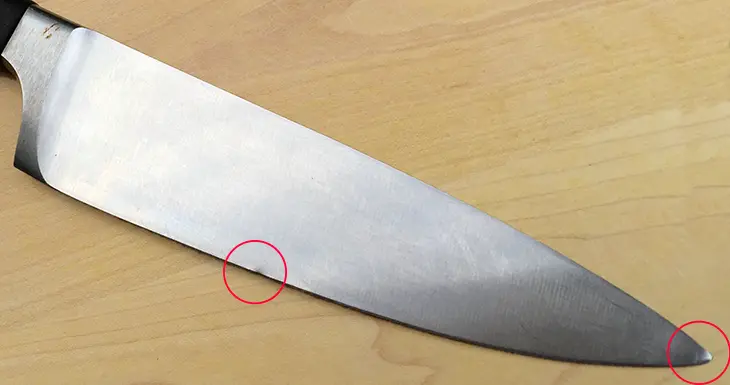
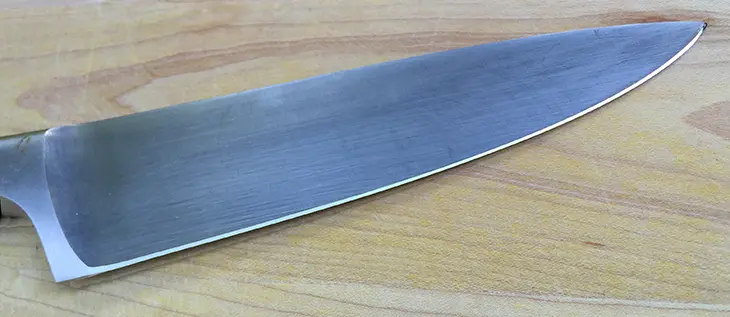
(Above: Wusthof Grand Prix chef knife with ding in the cutting edge and a bent tip. Below: Same knife after being sharpened and repaired by KySharp.)
– Sharp Stuff doesn’t do any repairs for free. Even a bent tip will cost $4. On the other hand, that same $4 will cover a whole range of issues—from a chip, to a swale, to grinding down a bolster.
Important note: With all of these professional sharpeners—if you have any repair issues you are not clear about, make sure and ask ahead of time. That way you’ll avoid any misunderstandings.
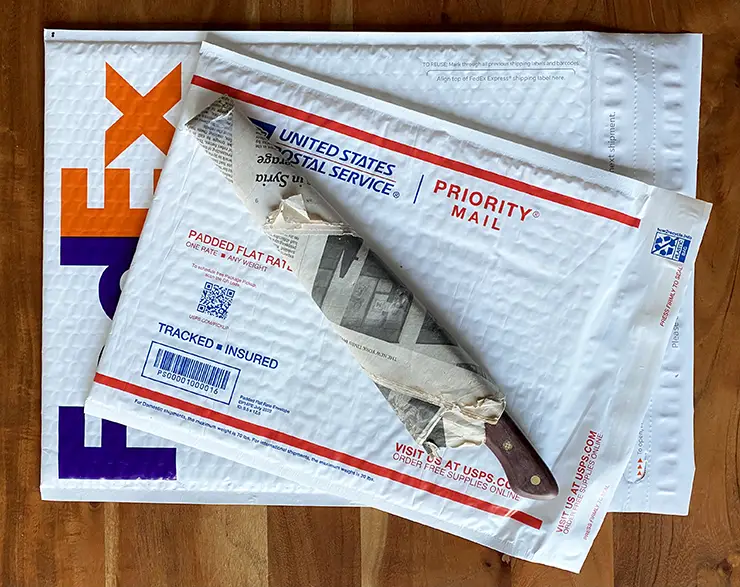
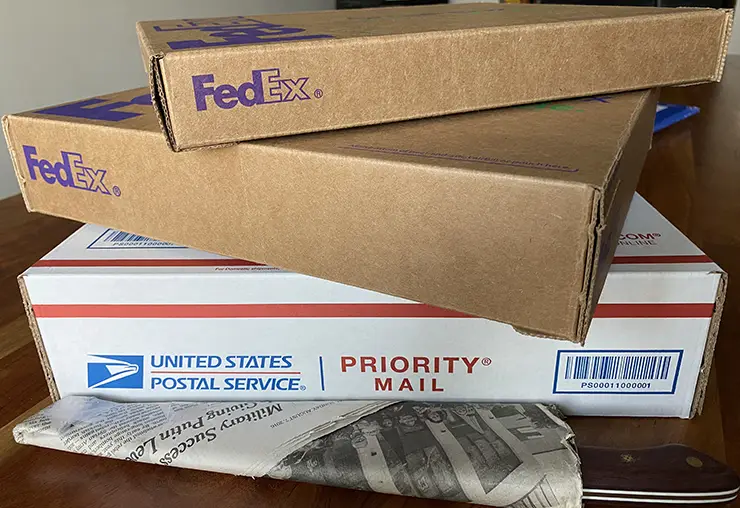
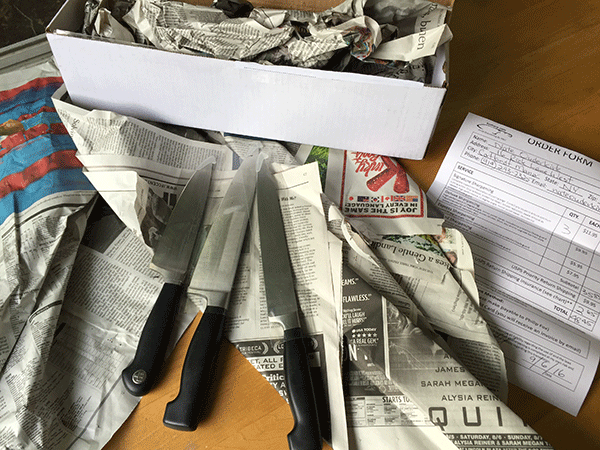
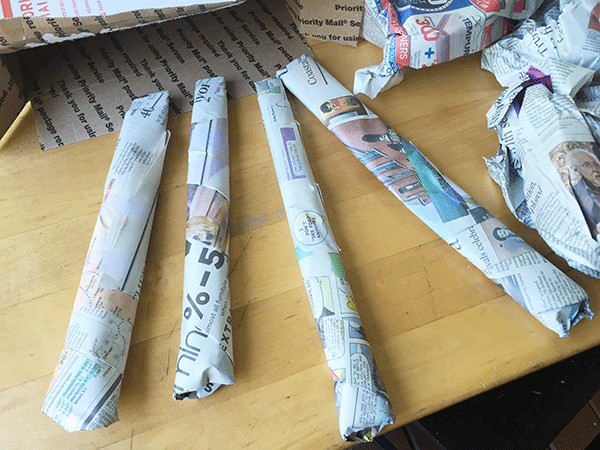
The simplest and cheapest way to pack up your kitchen knives is to wrap them in newspaper. Wrap each knife separately and secure with tape. (Don’t put anything special on the point.) There are styles and techniques of wrapping, but any kind of wrap that thoroughly protects the edge and point from doing any damage will work.
Here are two video links that show contrasting techniques—one on Bozeman’s site and another on Sharp Stuff’s. Steve at Sharp Stuff recommends wrapping your knives in an old towel. Personally, I prefer newspaper (Bob Tate’s method) because it’s more compact, more flexible, and will tend to weigh less.
This is where the knife nuts will all gravitate and everyone else just glaze over. . .
In the early days, when a batch of blades came in from a professional sharpener, I’d grab some magazine paper and sliver off corners with the newly-sharpened edges. Cool. Nine out of ten knives would perform excellently and whizz right through. I could tell all the knives were in the proper sharpness universe and certainly sharper than knives in at least 95 percent of all U.S. home kitchens. But I still felt I was skimping on analysis. I wanted a more accurate, and more consistent, basis of comparison.
After some trial and error, I’ve come up with a two-part system. . .
part one: Magazine Paper Test
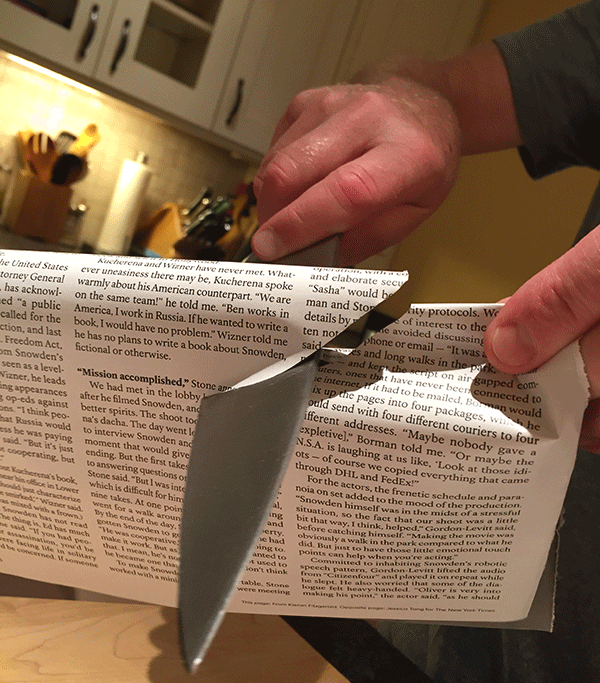
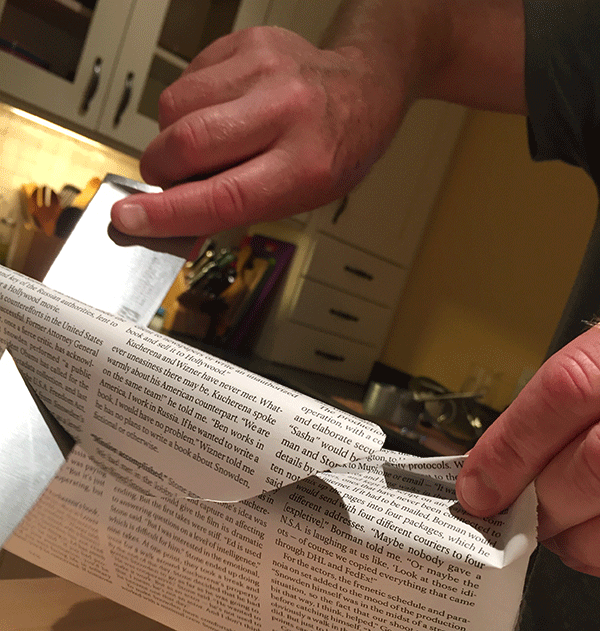
First, with each knife, I try to carve half moons through loosely folded-over magazine paper (as already mentioned—something I culled from Bob Kramer). The object is for the knife to enter and exit the paper without resistance and remove a complete half moon (really, more like an orange slice shape). Ideally, the edges of paper the knife cuts through should be smooth without any toothiness, thus, confirming a extra level of sharpitude.
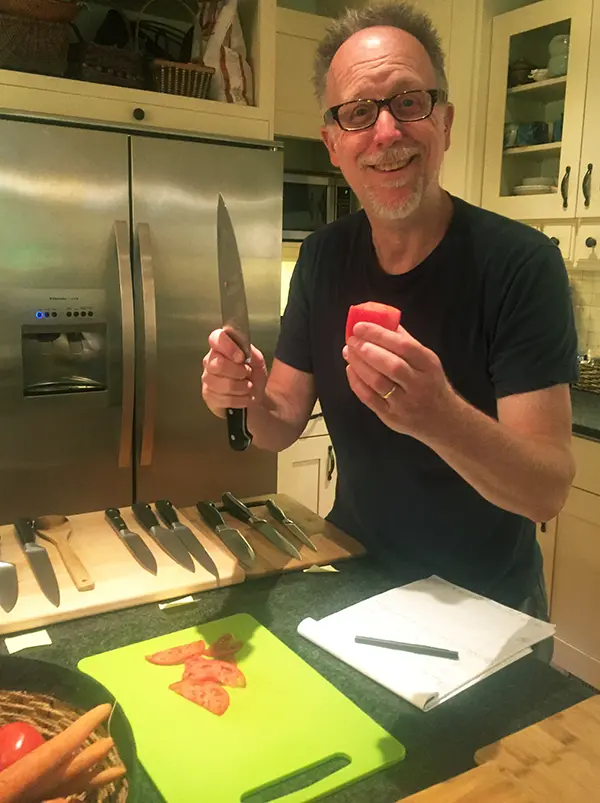
In short order I’ve discovered the magazine paper test is not demanding enough. Although once in a while I might find a knife that has a problem with exiting the paper, in general, most knives that come back can carve full, and pretty smooth, half moons. Darn. (Below: sharpness test with magazine paper.)
part two: Tomato Test
Second, I’ve added the classic and most knife-problematic vegetable to the mix—the tomato. (Yes, I know, it’s really a fruit.) I’ve quickly discovered tomatoes are much much better at revealing how sharp a blade is. Unquestionably more exacting than paper. Good, but I’ve needed to codify my procedure—because I wasn’t being nearly consistent and detailed enough in my recording of tomato data. (Wow, do I sound like a knife nerd or what?)
Number One, my tomatoes weren’t all the same exact type or in the same ripeness. Big diff, folks. And Number Two, I wasn’t paying close enough attention to exactly what kind of resistance, or lack or resistance, the knife edges were giving me all along the entire edge. Plus, I wasn’t applying the exact same types of cuts or being diligent enough about exerting the same amount of pressure. Ha!
But learning from these initial attempts, I’ve finally come up with a finalized series of parameters for testing knife sharpitude with a tomato.
Tomato Test Parameters
#1) The tomato: The best tomato—because it’s the most challenging—has proven to be a common, ripe, hothouse tomato. The kind most grocery stores sell all year round and come quaintly displayed in vined bunches. No plum tomatoes, too firm. No other kind of tomato in general, too firm. And no tomatoes that haven’t softened into ripetude.
#2) The cut: Every cut needs to be a push cut. First, because it’s a cut that demands the most from the cutting edge, and second because it’s fairly easy to track and control.
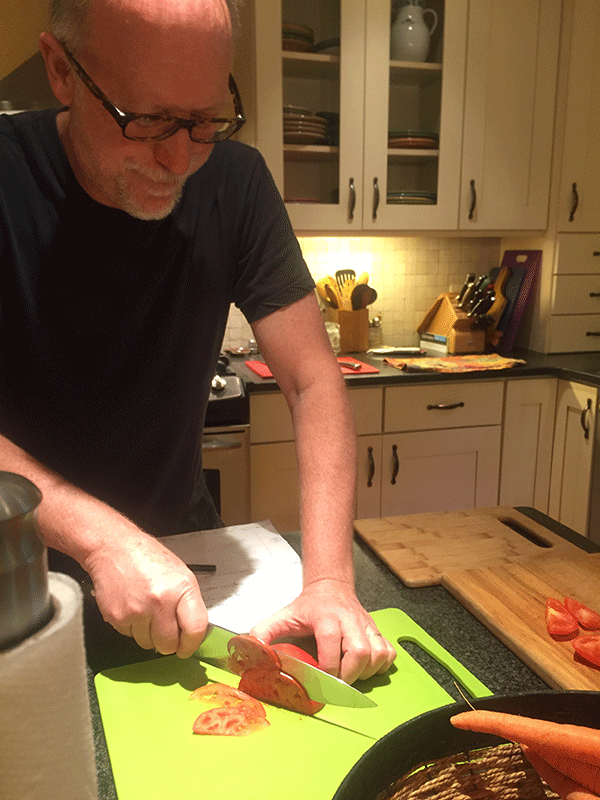
#3) Edge consistency: Multiple push cuts are needed to determine whether the sharpitude is consistent along the entire edge. To suss out weak spots. So I perform a minimum of three push cuts, each starts from a different area of the blade—tip, belly, heel. (Have you nodded off yet?)
#4) Pressure/weight: Ideally, a finely-sharpened knife should take very little downward pressure (or hand/arm force) to break through the skin of the tomato. And it should be one, uninterrupted push. Any need to saw back-and-forth is evidence of inferior sharpitude.
Unfortunately, because of the varying weights of the knives themselves (some widely), downward pressure is often the trickiest element to gauge. Larger, and older, knives that carry more heft always seem to slice more effortlessly. So be it . . . just something to be aware of.
SHARPNESS TESTING SYSTEMS Interestingly enough, in one of my queries to the pro sharpeners, I had asked one if he tested his edges to confirm their sharpness. And he’d said, early on in his practice, in an effort to precisely quantify how he was doing, he’d tried out the Edge On Sharpness Tester. But he had found the device so inconsistent that he quickly sold it and has since simply relied on his fingers, his eyes, and, in a pinch, shaving a few arm hairs—methods which seem to be the norm for most pros.
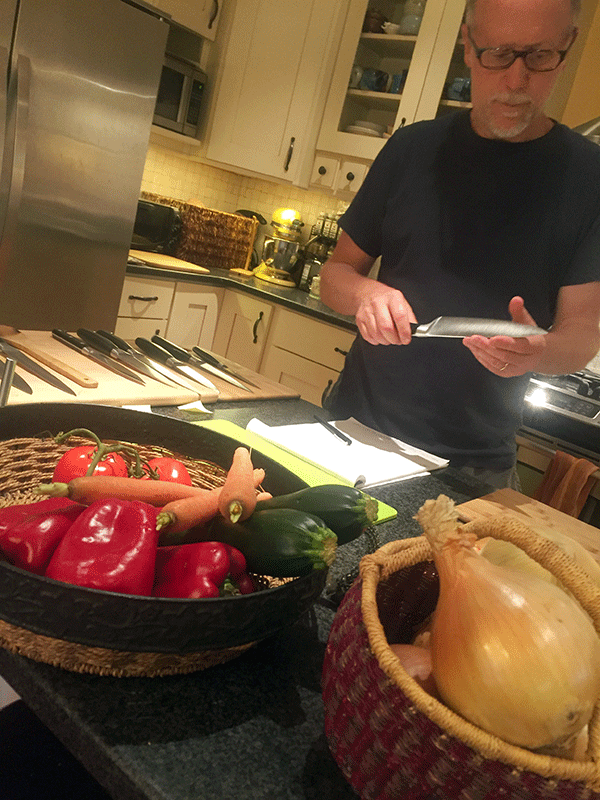
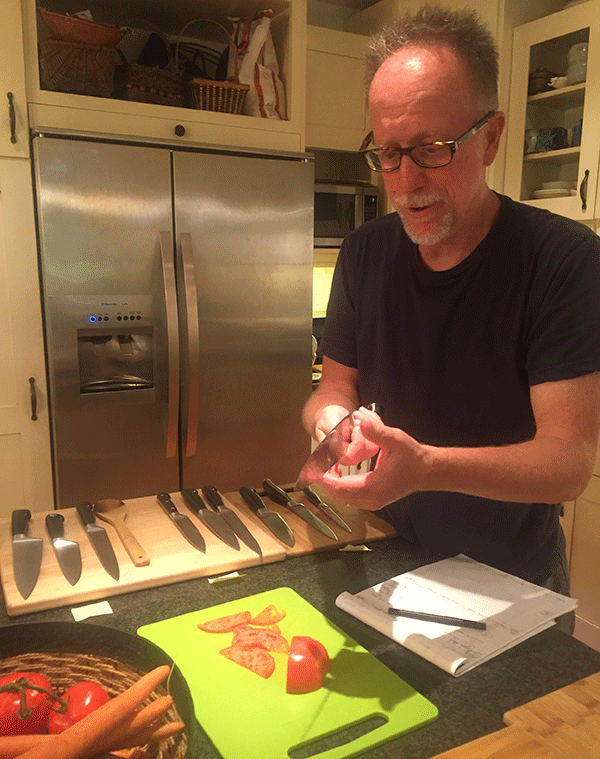
(Below: KKG’s journey through the Tomato Test for sharpness.)
Which knives I sent where. . .
Bozeman Knife Sharpening
Henckels Professional “S” chef, 8-inch
Henckels chef, 6-inch (natural wood handle)
Global G-48, 7-inch
Sabatier slicer, 8-inch
Calphalon santoku, 8-inch
Henckels Professional “S” paring, 4-inch
Henckels Four Star paring, 3.5-inch
KySharp
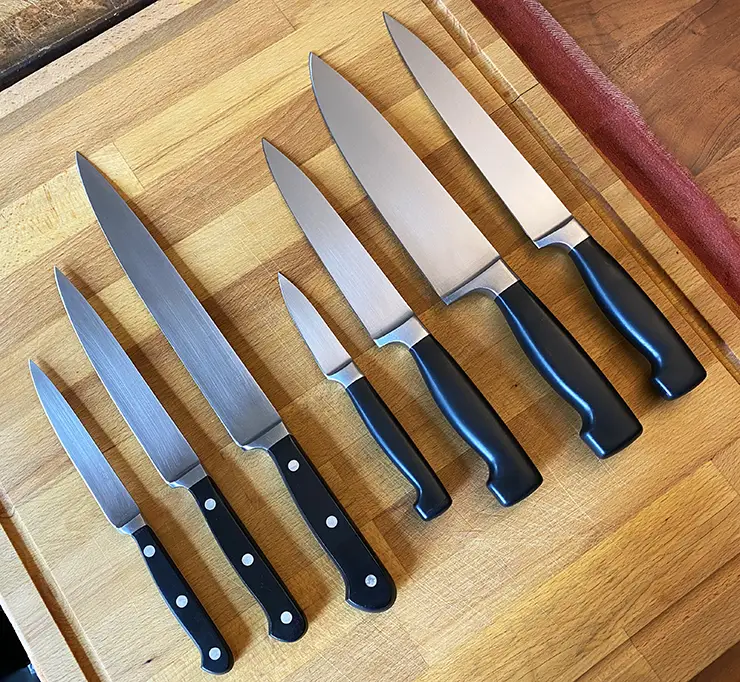
Wusthof Grand Prix chef, 6-inch
Henckels Four Star chef, 8-inch
Henckels Four Star slicer, 8-inch
Sharp Stuff
Wusthof Classic slicer, 9-inch
Wusthof Classic chef, 8-inch
Wusthof Classic utility, 6.5-inch
Wusthof Classic boning, 6-inch
Wusthof Classic utility, 5-inch
Wusthof Classic paring, 4-inch
69 Responses
Thank you for the great reviews!
I was wondering if you’ve received any feedback on, or have an opinion about, Zwilling J.A. Henckels in-house knife sharpening service. I have a large collection of Four Star II knives—most of which are in new or like-new condition (they all still have the red/black stickers on the handles), but they aren’t particularly sharp. Their service is fairly affordable, compared to the services you’ve reviewed, which I’m not sure I can afford. That said, I’d hate to send in a bunch of “new” knives and have them botch the job since, like you, I am very, very, very picky.
I’m also curious how different can I expect the knives to appear after professional sharpening. Will my “new” knives still look factory new or should I expect them to look like they’ve been altered? Many thanks for you help. :-)
Hi John!
Sorry, but I have no feedback on Zwilling Henckels’ knife sharpening service. As a matter of fact, after doing a thorough Google search, I couldn’t even find it. But no matter. . .
My experience in life dictates that, in general, you get what you pay for—and knife sharpening is no exception. Depending on the knife, Henckels’ service may be able to match their factory edges. And since you are talking about Four Star II knives, not any of Henckels’ Japanese-made blades, you may fare decently. But factory edges are often hit and miss and rarely the cat’s meow. Not a good match for a “very picky” home chef.
Of the knife sharpening services recommended in the article above, D&R is the closest to a factory edge and, thus, my least preferred. All the others—Seattle Knife, KySharp, RazoEdgeKnives, Art of Sharp—would clearly beat a factory edge.
My take? I would always opt for using fewer knives, but with sharper edges. Quality over quantity every time. So, if it were me, I would get three or four knives excellently sharpened and use them (and hone them) regularly, rather than have half a dozen or more blades with so-so edges. And, BTW, if you send your knives to Seattle Knife Sharpening I guarantee you will thank me for the rest of your life. I am not exaggerating.
As far as how different your knives will look, they will look different—especially with Seattle, since he goes further up the side of the knife in order to blend in his primary bevel. That’s the nature of getting a knife sharpened—whether you do it yourself or someone else does it. (Actually, D&R will probably look the least different since he tries to match the factory edge.) But once you start slicing and dicing and feeling such little resistance, you will totally forget about the way they look :)
Best, KKG
I just received my knives back from D & R Sharpening and could not be happier with them. The knives are sharper than they have ever been. The turnaround time was very quick – just over a week until I received them back in the mail. I haven’t used the other knife sharpening services mentioned here, but I would definitely give D & R a thumbs up.
Thanks, I have never had them sharpened at all, so I don’t think they are worn down, although they are 10 years old. I have the hone that came with the set. I have used it but never seemed to make a difference, I even watched a video on a TV cooking show once. UNTIL I watched yours, you showed a different technique. I tried your way, and even though they are 10 years old and never been sharpened, WOW is all I can say. It really made a difference. Thanks for that honing video! I am considering sending them out to the place you sent yours, but there is a place in Grand Rapids called Williams and Sonoma that does sharpening, but I wonder if they know what they are doing. Any comments on places like this?
Kit, I can’t speak for every Williams-Sonoma store. But my impression is that the kitchen goods stores do not use high-quality sharpening services. They seem to be more interested in selling customers knives than getting their knives properly sharpened.
If they were my knives, I would send them to one of the pro sharpening services I recommend. Seattle Knife Sharpening is the very best, but a bit pricey, especially when you figure postage. One of the new sharpening services I’ve added, Art of Sharp in Chicago, is nearer you, would do a fine job, and save you a little money.
Best, KKG
Hi, not a professional chef, just love to cook. I have a set of Wusthof Classic knives. I am frustrated that I can not seem to get them really sharp. Are they worth spending money on or should I replace them?
Hi Kit,
You’ve come to the right place! And your experience reflects my own frustrations. Learning how to sharpen a knife properly to a fine edge is a task that takes much patience and training. I’d rather leave it to a pro.
And now your question. . .
1) Wusthof Classic knives are definitely worth spending money on to get super-sharp. The quality of the steel in the blade will enable them to take a sharp edge and hold it—especially if you hone them regularly with a ceramic hone. This is not Japanese-knife sharp, but definitely sharp enough for most kitchens.
2) The only reason your knives would not be worth getting professionally sharpened would be if they had been worn down a lot (mainly from sharpening, or worse yet, improper sharpening), OR, had deep dents in their edges that would require taking a lot of metal off in order to sharpen properly. (I show an example of this in my article Finding a Professional Sharpening Service.) In this case, you might consider starting from scratch. But you could decide on this on a knife-by-knife basis.
3) All of the sharpening services on this page should send your knives back to you as sharp as or (more likely) sharper than they came from the factory. So got for it!
4) Read my article Kitchen Knife Sharpening Action Plan and Do What It Says to Do!
5) Since you love to cook, for the fun of it, you might want to try out a Japanese hybrid chef knife. Check out some of the terrific deals available in Quality Kitchen Knives on Sale.
Best of luck,
KKG
I have been sharpening knives for about 15 years and I use a Tormek machine because the wheel travels thru water and that keeps the blades cool and I can control the angle that I want. I do sharpen serrated knives, but I know that there must be a better method then I use. So. . .does anyone have a method that they use that works really well, other then using a file and doing each serration individually?
Hi Gene,
This web page is mainly for consumers looking for a quality professional sharpening service so that they can compare notes and share tips. But other sharpening services have already gotten into the act, so I suppose you’re welcome to give it a shot :)
—KKG
I tried a 14″ Freidrick Dick steel hone on a Kanetsune 240 mm VG10 laminated gyuoto, noticed a few chips, I didn’t hone very hard, quit using steel on VG10.
I find it easier to sharpen my own than the process of sending them out. I used to buy blades, put handles on them, and make sheaths. My glass business took off and I quit “making” knives. I still have a few friends that occasionally ask me to sharpen their knives, none of which are really hard steel, so I use the belt sander and buffing wheel on them. I try to evaluate the condition of the edges to determine what kind of angle to sharpen their knives. One friend uses his pocket knife to cut anything, sometimes I think including bricks. He gets a fairly obtuse angle.
You made me smile while imagining someone cutting bricks with a knife:) He’s lucky to have you as a friend! —KKG
I have several Japanese laminated blades with VG10 and SG2 cores. I have not had good results with a steel and VG10 and have quit using one on my VG10 and SG2 knives.
I have two Smith’s 11 1/2-inch diamond stones, a coarse and a fine. I haven’t needed the coarse on my knives, but previously could have used it if I had it. I follow up the fine stone with leather strops imbedded with 1 micron and 0.1 micron diamond dust. The length of these stones is useful for removing a belly or straightening a wave in an edge (by going mostly lengthwise across the stone with the blade), and then using a more traditional angle to finish the edge. Usually my touch-ups are done with the leather strops.
I sharpen to a thin angle, have an end-grain board, and am very careful not to abuse my edges. I sometimes sharpen my “normal steel” (440C, AUS8, 1095, etc.) knives on a belt sander (wetting the blade each pair of strokes) and finish with green chrome on a buffing wheel. Either technique, scary sharp.
Hi Chef Jeff,
Thanks for sharing the techniques you use to keep your knives “scary sharp!”
RE honing/steeling VG10 blades: Were you using a steel hone or a ceramic on your VG10s and SG2s? Because for over two years I’ve honed my Japanese Shun Classic (with a VG10 core) with a DMT ceramic hone and had wonderful results. It’s kept the blade reasonably sharp and not inflicted any damage. If you were using a ceramic hone, I’m guessing our different responses may be due to that fact that you demand a higher degree of sharpitude in your kitchen than I do :) Otherwise, you may want to give a ceramic hone a try sometime!
RE sharpening: As I freely confess on these pages, I’m a whimp when it comes to doing my own sharpening. As a stay-at-home Dad who cooks, runs a biz, and tries to keep his house properly maintained, using a honing steel is all I have time for. And, judging from reader’s comments, I think most visitors to this site are in the same boat. They would be doing well if they simply honed/steeled their kitchen knives on a regular basis :)
Best, KKG
Hey there,
As it’s been a few years since you wrote the original article, I was wondering if you could share your thoughts on the durability of the edges you got from each company. You gave some predictions in your article, just curious if reality has met your expectations and which blades have dulled the most after the first year, etc, etc.
I’m especially interested in whether D&R and Just Knives wore in the same way—they seemed to be roughly equal in initial sharpness. If they’ve proved to be equal in durability, I’d see no reason not to go with the cheaper option. I’d also like to know if Seattle stayed sharper longer as predicted, and whether you’ve had any instances of damaging your knives due to his thinner technique. I think that could be the last piece of the puzzle when it comes to selecting which company I want to use. Thanks!
Hi Patrick,
Thanks for your inquiry. Good question! Unfortunately, I cannot give you a definitive answer about the durability of D&R and Just Knives sharpened edges. I have not tracked them that closely, but, my general impression is that they are very similar to each other.
What I can tell you, without a doubt, is that there has continued to be no comparison between their edges and those of Seattle Knife Sharpening. Seattle’s edges were not only the sharpest, but have lasted and lasted—way beyond what knives from the other two outfits would ever be capable of.
The reasons are 1) geometry and 2) finish.
1) Geometry: Seattle does not use the typical primary bevel that most Western knives come from the factory with. Bob Tate creates one, continuous bevel from the spine to the edge. This gives his knives a thinner edge that stays sharp much longer. And, no, I have not run into any problems with his edges being too thin or too delicate. But I do NOT abuse my knives—I treat them with care.
2) Finish: Seattle goes through more steps in his sharpening process and brings his knife edges to a much finer, much more polished, final edge. Way beyond your average factory edge and way beyond most other professional sharpeners—other than traditional Japanese hand sharpening on waterstone.
So, if you are like me, and really appreciate quality and want your kitchen knives to stay sharp as long as possible, I would highly recommend using Seattle. They are unique!
Please make sure to check out The Power of Honing a Knife where I show what one of my chef knives can still do three years after being sharpened by Seattle Sharpening. It’s pretty impressive. (Of course, I’ve honed regularly with a ceramic steel.)
Best, KKG
Hi Knife Guru,
Thanks for this great article on reviewing online sharpeners. I have been sharpening for years, but recently had a friend help me build up a website. I sharpen pretty straightforwardly using the Edge Pro method mainly. I listed your article on my smart sharp blog. I think a lot of my friends/family/clients would be intrigued to see what’s out there.
I like all the comments that pile up on your article. You’ve got quite a complete list of the online sharpeners around that are quality. Thanks for this. Be well!
Eric
Hi Eric,
Thanks for checking in!
I must admit I had to chuckle when I read on your website how you strive to match the exact angle of the knife you’ve been given. I don’t want a sharpening service to match my factory edge, I want them to improve on it! (See my article Best Chef Knife — Don’t Overrate the Factory Edge where I spout off more about this.) But I hear you loud and clear about only taking off the minimal amount of metal necessary. That’s a must.
Best of luck with your business and new website! The Edge Pro system is probably the way I would go if I ever managed to carve out the time to sharpen my own kitchen knives :)
Best, KKG
All my knives are Cutco products. Are you familiar with the brand? Do you have any suggestions on sharpening these knives? Thank you.
Hi Sondra,
Yes, I’m familiar with Cutco knives. But I must admit they’re not my favorite brand. There are other brands I much prefer that are better value for the price and will hold their sharpitude longer. See my article Best Chef Knives. . . for more details.
Nonetheless, there is one neat thing about Cutco — any knife you buy from them they will sharpen for free forever! Here’s the link:
https://www.cutco.com/customer/sharpening.jsp.
Otherwise, if you send your Cutco knives to any of the sharpening services I’ve reviewed in the above article, they will do an excellent job!
Best, KKG
Hi, Nate:
Just wanted to add that I recently had a very good experience with Razor Edge Knives (razoredgeknives.com) located in Greenville, SC. So, they may be a good option for your readers located in the Southeast U.S. I sent them six of my good kitchen knives—Wusthof and Henckels—including two serrated edges. For a very reasonable price, they put a very sharp edge on them and polished the blades. Turnaround time, including shipping, was one week.
I am a home cook trying to learn and improve my skills, not a trained chef, and really appreciate your articles and videos. Based on your info, I recently purchased the ceramic steel you recommend which I had always lacked the confidence to try.
Keep up the good work!
P.S. I am not affiliated with REK in any way. Just found them via Google and decided to try based on other reviews and because they are located closer to me so shipping time would be less.
Thanks, Walter, for the feedback and the tip! I took a quick look at Razor Edge and they look pretty solid. If I ever get any free time again, I might try to review them :)
The only thing I might mention is that, on their German knives at least, it looked they were ending in a very short primary bevel which is not my favorite style of sharpening. (It’s the way kitchen knives come from most manufacturers though.) My favorite style is what Bob Tate of Seattle Knife Sharpening does and that is to blend the primary bevel entirely into the side of the blade so that it’s just one long, continual bevel. The reason I like this unorthodox style (and why Bob employs it) is that it makes for a very thin edge that lasts and lasts. (With proper honing, of course.)
—KKG
I think it’s a bit unfair to compare these services based on how subjectively sharp they returned your knives. That one was sharper than the others was likely due to a judgement call and not to skills or techniques. All these guys are capable of sharpening blades to the point where you are not going to be qualified to bicker about them, unless you’re a professional sushi chef (in which case, you’re doing your own knives every night).
Mr. Tate most likely thinned your edges to a more acute bevel angle than the other two. He chose performance over durability. The others would have done this had you requested it.
I would imagine the real differences between the three are matters of service and value. They can all sharpen the hell out of a fancy knife.
Thanks for your opinion, Paul, but I heartily disagree!
There is a distinct, qualitative, difference between what Bob Tate at Seattle Sharpening does and what the other two services do. Have you read my interview with Mr. Tate — Interview with a Sharpening Service. . .? Do you realize he was trained by Bob Kramer one of the master knifesmiths of the world? I have a chef knife that Tate sharpened over three years ago that still cuts paper. (Of course, I treat it right and hone regularly.)
That’s not to say there’s anything shabby about the other two services. As a matter of fact, Dave Martell of D&R Sharpening is a highly-respected master of Japanese sharpening techniques on waterstone. But he has two discretely different services he offers: 1) what he calls “Regular Sharpening” (for Western knives made of German steel) and 2) “Hand Sharpening” (for Japanese Western style knives, made of Japanese steel). When I sent my knives to him a few years back, all my knives were German. And when I asked Dave about how he would sharpen my Henckel’s knives, he said he preferred to do them the standard way (how they usually come from the factory), with a narrow bevel sharpened at 22 or so degrees.
Contrastingly, Tate’s technique is to create one extremely long and gradual bevel starting from 1/2 to 3/4 of-the-way up the side of the blade (depending on the knife). He does this on both Western and Japanese-Western style knives. On your average chef knife, the bevel may begin an inch away from the actual cutting edge. This ends up giving you an edge of 15 degrees or sharper, and yes, the edge will not be as indestructible as a typical factory edge. But, if you know better than to use your chef knife to power through chicken joints, the edge will hold up just fine. Especially if the knife is made of German steel (which is tougher than Japanese).
If you have a passion for quality (and I think you do, judging from your website), you owe it to yourself give Seattle Sharpening a try!
—KKG
P.S. I’d be a little careful about specifying bevels with sharpening services. Trying to create the kind of bevel that Tate creates, without having had plenty of experience, could result in permanently damaging a knife.
Hi Nate:
My husband and I have a mobile sharpening business located in Hudson, New York. We use the Edgemasters system mounted in a Dodge Sprinter and service restaurants within an hour of us, as well those home kitchen chefs who appreciate the value of a good edge. Hudson is a hot bed of the farm to table movement and full of foodies. Our business is only a year old but we have quite a few chefs who are very loyal and will only trust their knives to us.
I have found your website to be very informative and interesting. I just put a link on our FB page to your article on choosing a knife because we are asked quite often which are the best knives. I want to thank you for your thoughtful opinions. I think I will be tapping your site pretty often.
We are 2 hours north of Manhattan. Perhaps you will give us a try for future sharpening needs.
Eileen Sheets
ProSharp Mobile Sharpening
Thanks, Eileen, for checking out KKG! Yes, Hudson and Duchess County (NY) are one of the places to be if you’re serious about food. I just ordered Modern Farmer magazine that’s centered in Hudson as well. Maybe some day I’ll take a looooong drive up your way and check out the whole scene :)
Best, KKG
Dear Guru,
I’m trying to help out my sister. We’re both getting up there in age (I’m the young one at 63!), but I try to build or fix whatever she needs on the farm. Her son gave her a set of Henckels Eversharp steak and kitchen knives. I’m sorry, but to me they seem the most worthless group of knives I’ve ever used! If they cut at all they just tear through stuff—but most of them don’t cut worth a darn! This Thanksgiving they just tore the turkey apart—more like pulled turkey than cut pieces! Geez, that was an abuse of good meat!
Recently, I bought a Work Sharp Ken Onion edition knife sharpener for my military, work, and hunting knives. Seems to get a really nice edge to my knives and keep them that way for a long time. Can I use that belt sharpening system to sharpen those crappy Henckels steak knives? (I’m half convinced I should grind off the serrations and start over on them—but before I go nuts, could you give me some suggestions how I could sharpen her knives up?) Would it ruin crappy knives to try to slowly grind on a better edge?
Geez, that would be great. I appreciate your time.
Best regards, Ken Johnson
Ken,
I’m sorry but I am not, nor do I claim to be, an expert on the nitty-gritty details of knife sharpening. That said, from what I understand about sharpening, trying to sharpen a serrated edge is extremely challenging and, no matter how much of an expert you are, will not yield the amount of improvement gained when sharpening a normal edge. To add to this, the knives you’re talking about have a micro-serrated edge which would be impossible to sharpen and keep the serrations. You would have to simply grind off the serrations which would be pointless and would make the knives worthless.
Henckels makes a vast array of kitchen knives that vary greatly in quality. And Eversharp is a stamped, inexpensive, low-quality line. So, please don’t get the wrong idea that Eversharp is the best Henckels can do. That would be totally inaccurate. For more about what Henckels lines I recommend, please see my article on best chef knives.
Best, KKG
Sharpening serrated knives is actually quite easy as you can sharpen the flat side and leave the serrations intact. However after multiple sharpening with this method, the serrations will disappear.
This is one of the more in-depth articles I’ve read on knife sharpening services and sharpening rates which a lot of people forget to compare. Above you mentioned how Seattle’s prices were more than Just Knives and I know you hit the nail on the head when you said it was due to how the knives were sharpened.
I have a knife sharpening service and offer 3 different edges that I can put on knives and charge accordingly. I’d say 90% of services use some sort machine to sharpen their knives and charge a bracketed rate or a 1$ per inch. Machine sharpened edges are a” quick and dirty” way to sharpen a blade, but are quick for the sharpener to do. There are a few disadvantages to sharpening a knife this way such as removing more blade steel than necessary. A hand sharpened edge is more time consuming. It does result in a much more refined edge, as you mentioned, because of the slower more detailed process. Is it worth it?
What I advise people when they ask is to tell me about their knives. Generally, if the knife is old, poor quality or beat up, I suggest a machine sharpened edge as the knife probably won’t hold an edge for very long regardless-it’s what most people consider to be sharp anyway. For “good” knives to very high end cutlery I firmly suggest having the knife sharpened by hand. I try to inform the customer as much as possible about what I can and can’t do to their knives.
I also have a mail-in knife sharpening service at http://www.eliteedges.com and do charge for return shipping but don’t understand why some other services charge a handling fee on top. All of the packages go out at the same time so there is no real added cost. Anyway good article and please advise your readers to compare services, methods, and prices to get the most for their money.
Dan—thanks for your comments and observations!
Let me just clarify, in case somebody gets the wrong impression, that Seattle Sharpening does NOT hand sharpen. Bob uses a series of variable belt sanders and polishers that have been customized. And when I asked Bob about hand sharpening versus machine, he felt the most important element in the whole process was the skill and perfectionism of the human doing the sharpening. (If anyone’s interested in hearing more from Bob, read my in-depth interview with Seattle Sharpening.)
Best, KKG
P.S. KKG visitors: For the record, I have not used EliteEdges or reviewed them. But they sound like a high-quality outfit—thus, I have supplied their hyperlink above for my readers to click on and check out for themselves.
I would like to comment on the machine versus hand-sharpening methods. Yes, some machines will remove a lot of metal and leave a poor edge at best.
However, after 40 years of making and sharpening knives, I believe that I can obtain as good of an edge with my 2- by 72-inch belt grinder as the ancient masters could with their waterstones. Today’s belt technology is really fantastic.
Sure I could sharpen knives by hand, but would have to charge a much higher price for it and still not have the ability of removing that blob of metal on some chef knives, called a bolster, that is directly in the way of sharpening and also leaves the blade off of the cutting board. I usually hollow grind most of it away and it looks clean and professional.
Sometimes knife sharpening is more like knife restoration as I take out the blade sway, restore the rocker edge, lower the bolster, regrind or straighten the tip, thin the edge back a ways and of course put on a screaming sharp edge.
I have serviced many happy repeat customers for the past 20 years at Bronk’s Knifeworks, Country Village until they decided to sell my shop to a condo developer.
My new sharpening shop is presently located at 19510 Bothell/Everett Hwy.
I have long been under the impression that machine sharpening generates too much heat and can damage the metal’s temper. For the guru and the pro sharpeners, what are your opinions about that issue?
Hi Brad,
I touch on exactly what you’re talking about in my article Finding a Professional Sharpening Service. This is one of the main reasons it’s so important to find a credible pro sharpening service and was a driving force behind creating this website.
It all depends on: 1) what kind of machine and belts the pro sharpener is using, 2) how fast the machine is running, and 3) the skill/know-how of the operator.
All pro sharpeners that I use, or recommend, run their sharpening belts (or wheels) at much slower speeds than if they were doing serious grinding. Some have specially customized machines. This helps control the friction/heat as well as ensure the machine doesn’t take off any more metal than is absolutely necessary. A pro might also use a machine that water-cools the wheel/belt and, if not that, regularly dip their blades in a water bucket to cool them off. For traditional Japanese blades, there is a waterstone wheel that can be used that operates at very low speeds, sort of like a record player. (After using the wheel, a Japanese sharpener may then continue with manual sharpening at higher grits.)
It’s all about controlling the heat. But there’s no reason why a skilled operator, using the right machine, can’t sharpen a kitchen knife to a razor edge without ruining the temper.
Dan, of Elite Edges, feels he can produce finer, more perfectly polished edges, using hand sharpening. He is welcome to his opinion. . .and it may be be the best route for traditional Japanese blades. But, regardless of this, I don’t believe he is saying that a machine-sharpened approach MUST destroy the temper.
If you’re hungry for more, you might want to check out my two-part interview with Bob Tate of Seattle Knife Sharpening!
Best,
KKG
I’ve been a knife maker for the past 37 years and have sharpened thousands of knives over those years professionally as well.
Born and raised in Montana, I moved here to Country Village, Bothell, WA in 1995 and set up a knife shop where I still work today.
I’ve known Bob Kramer for as long as I’ve been here and now share a shop with mastersmith Michael Rader who makes beautiful kitchen cutlery as well.
I make a few kitchen knives from 52100 and other steels, but work mainly on my Xross Bar Lock folders these days.
Nice to meet you, Lyle! After taking a quick tour of your website, it looks like you’re the real thing. . . :)
Country Village sold part of the village, that my knife making shop was located on to a developer, and I have been displaced. My new digs are at 19510 Bothell Everett hwy, Bothell, WA.
It has been a good move in many ways as I’m more visible with a street sign and I have been blessed with very good ratings.
2017 looks like it will be a banner year and I will be pressed to keep up with the knife making part as the sharpening side has increased greatly.
Thank you Nate for sharing!
Fantastic article and so easy to read.
Iam waiting for more!
Cheers
Luc
Thanks, Peter, for your feedback! One of these days when I find time to write a review of Japanese-style sharpening services, you’ll be on the short list for consideration :)
I’m loving your site, very interesting and full of useful information.
You mention Tosho Knife Arts in Toronto. While I have not used them for sharpening since I do my own, I have heard nothing but great things about them and Dave Martell speaks highly of them. Another place in Canada is Knifewear, Kevin the owner is highly respected in the sharpening world, I’ve seen their work and would trust Knifewear completely.
I personally do not charge for chips, nicks and tip repairs, it’s all just part of the service in my opinion. If people are good enough to trust me with their knives, it just makes sense for me to return the favour by sharpening them to the best of my ability. If that includes some chip repair so be it, so $1.25 an inch it is. Regardless of whether or not the knife looks like it was dragged behind a car for an hour.
Regarding Korin….Master Sugai is my idol :)
I used Bob Kramer for sharpening my knives when he was in Seattle and Bellingham, WA, and I could visit and talk to him. When Bob stopped sharpening, I followed his advice and have been using Bob Tate ever since. I agree with all you said about him. My one additional comment is that for a Seattleite, or even an occasional Seattle visitor as I am now, the turnaround is one to two days and no $10 fee if you can drop off and pick up at one of several UPS stores.
Thanks for chiming in, Randy! You’re lucky you live within driving distance of one of my favorite knife sharpening services (Seattle Knife Sharpening). I’m envious :)